About Eucalyptus exserta F.Muell.
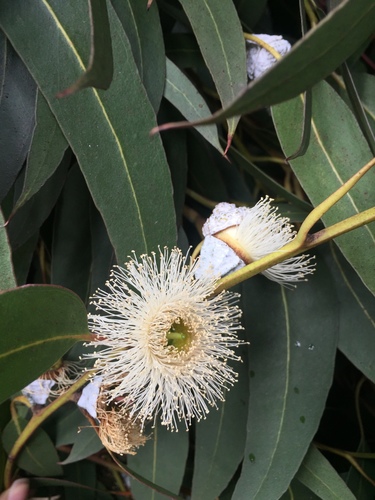
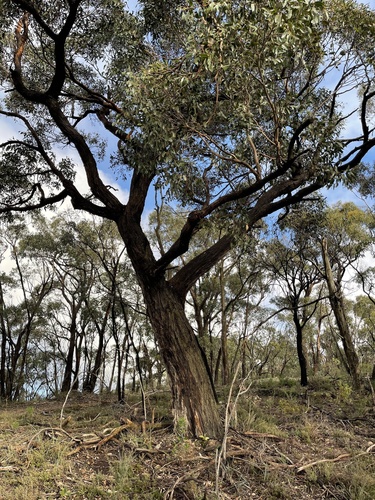
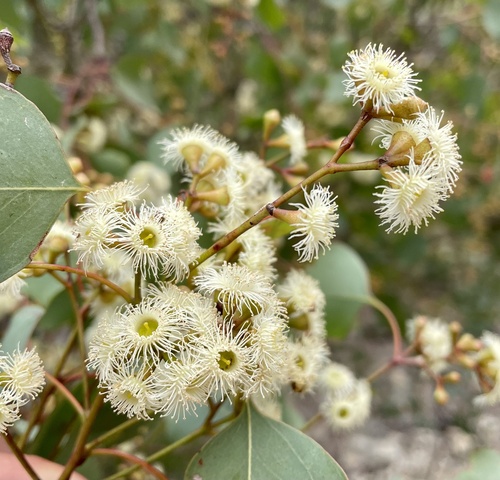
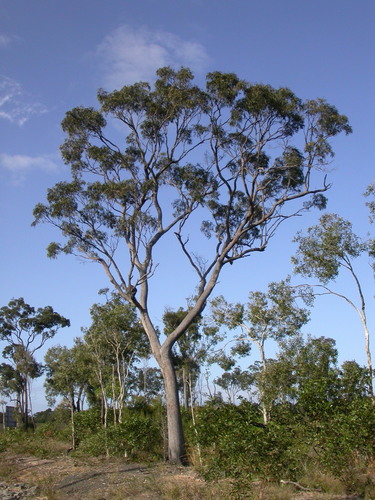
Eucalyptus exserta F.Muell. can grow either as a mallee reaching 5 metres (16 feet) in height, or as a tree up to 20 metres (66 feet) tall, and it forms a lignotuber. It has hard, rough, fissured, fibrous grey bark that typically covers the tree from the base all the way up to its small branches. Adult leaves are usually green, with a texture ranging from slightly glossy to dull. They are arranged alternately along stems, are narrow lance-shaped to lance-shaped, measure 65–180 mm (2.6–7.1 in) long and 7–27 mm (0.28–1.06 in) wide, and grow on a petiole 8–20 mm (0.31–0.79 in) long. Flower buds grow in groups of seven in leaf axils, on an unbranched peduncle 6–20 mm (0.24–0.79 in) long, with individual buds attached to pedicels 2–7 mm (0.079–0.276 in) long. Mature buds are oval, 7–11 mm (0.28–0.43 in) long and 4–7 mm (0.16–0.28 in) wide, and have a conical operculum. Flowering has been recorded in January, May and December, and the flowers are white. The fruit is a woody hemispherical or cup-shaped capsule 2–7 mm (0.079–0.276 in) long and 4–8 mm (0.16–0.31 in) wide, with a raised disc and exserted valves. This species is found on stony rises and hills across most of central, southern and eastern Queensland, ranging from the Charleville area east to the coast, and extending north to Mareeba. It also occurs in a small area of northern New South Wales, in Bebo State Forest. Eucalyptus exserta grows in infertile sandy soils as a component of dry sclerophyll woodland communities. It acts as a host tree for the mistletoe species Amyema miquelii, Dendrophthoe glabrescens and Dendrophthoe homoplastica, and its leaves are a food source for koalas. Eucalyptus exserta flowers prolifically and has some importance as a food source for honeybees. It can be cultivated as a shade or windbreak tree on farms in its native range, and grows best on well-drained soils. In the early 1960s, Eucalyptus exserta plantations were established in Guangdong Province, China to reduce soil erosion.