About Eucalyptus cypellocarpa L.A.S.Johnson
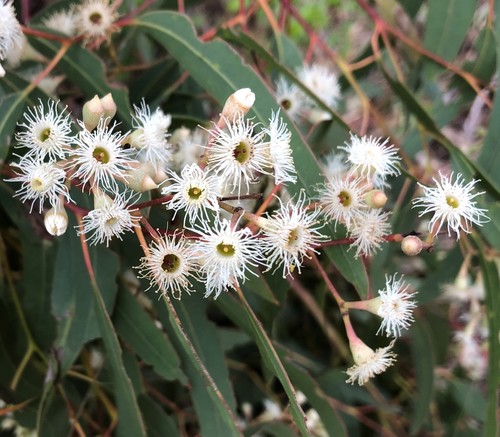
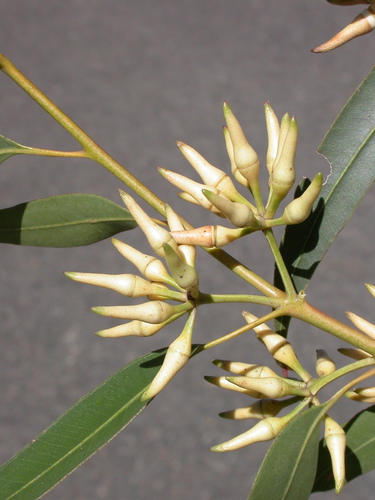
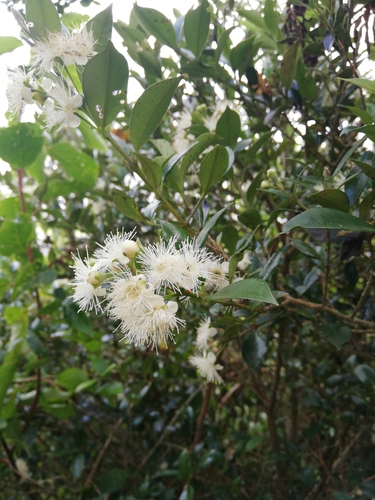
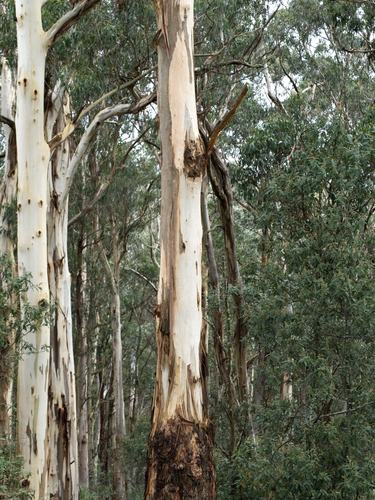
Eucalyptus cypellocarpa, commonly known as mountain gum, is a tree that typically reaches a height of 50 to 65 meters (164 to 213 feet) and forms a lignotuber. It has smooth white, grey or yellowish bark that is shed in long ribbons. Young plants and coppice regrowth have square-shaped stems in cross-section, and sessile leaves that range from lance-shaped to heart-shaped or egg-shaped. These juvenile leaves measure 45 to 120 millimeters (1.8 to 4.7 inches) long and 18 to 55 millimeters (0.71 to 2.17 inches) wide. Adult leaves are lance-shaped to curved, usually the same glossy green shade on both surfaces. They are 90 to 305 millimeters (3.5 to 12.0 inches) long and 10 to 48 millimeters (0.39 to 1.89 inches) wide, attached by a 12 to 32 millimeter (0.47 to 1.26 inch) long petiole. Flower buds are arranged in groups of seven in leaf axils, growing on an 8 to 22 millimeter (0.31 to 0.87 inch) long peduncle. Individual buds are either sessile or borne on a pedicel up to 7 millimeters (0.28 inches) long. Mature buds are green to yellow, oblong to oval, 8 to 11 millimeters (0.31 to 0.43 inches) long and 3 to 6 millimeters (0.12 to 0.24 inches) wide, with a conical to beaked operculum. Flowering occurs from January to June and from October to November, and the flowers are white. The fruit is a woody capsule, usually cylindrical or barrel-shaped, and sometimes cup-shaped or hemispherical. It is 5 to 10 millimeters (0.20 to 0.39 inches) long and wide, and is either sessile or on a pedicel up to 6 millimeters (0.24 inches) long. The valves of the fruit are usually held below the rim level. This species is found in New South Wales and Victoria, Australia, where it grows mainly in wet sclerophyll forest, in gullies and on mid-altitude hillsides, between 30.25 and 39 degrees south. It grows at altitudes from near sea level up to 1,200 meters (3,900 feet), in cool to warm, humid to sub-humid environments with temperatures ranging from −2 to 31 °C (28 to 88 °F), and annual rainfall between 700 and 1,300 millimeters (28 to 51 inches). In New South Wales, it is widespread in wet forests south of Tamworth. In Victoria, it is widespread in the south-east, including the Black Range, Grampians and Pyrenees.