About Eucalyptus cephalocarpa Blakely
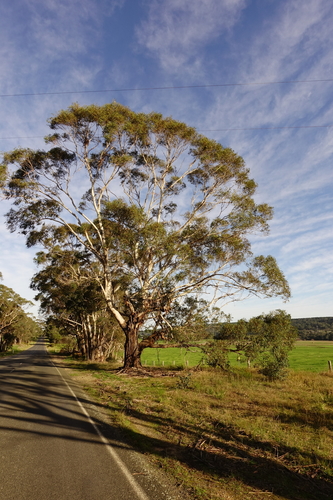
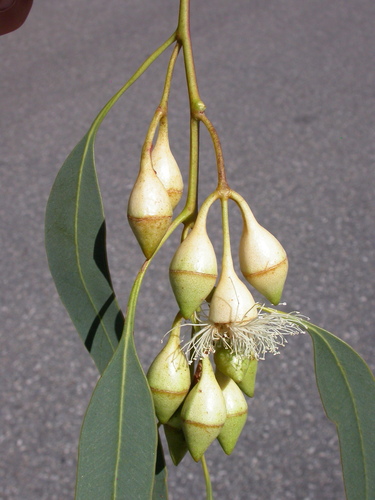
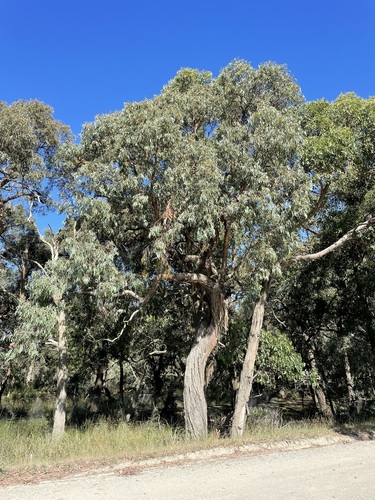
Eucalyptus cephalocarpa Blakely is a eucalypt tree that grows between 15 and 24 metres (49 to 79 feet) tall, and forms a woody lignotuber. It has thick, soft, fibrous, grey-brown fissured bark covering its trunk and larger branches, while the thinnest branches sometimes have smooth bark. Leaves on young plants and coppice regrowth are arranged in opposite pairs, typically bluish green and glaucous, shaped egg-shaped to nearly round, between 25 and 85 millimetres long, 17 to 65 millimetres wide, and are sessile (without a stalk). Adult leaves are shaped lance-shaped to curved, 85 to 250 millimetres long and 8 to 30 millimetres wide, borne on a 6 to 22 millimetre long petiole. Both sides of adult leaves have the same green to bluish colour. Flower buds are arranged in groups of seven in leaf axils, on an unbranched peduncle 4 to 18 millimetres long, with individual buds attached to a pedicel up to 3 millimetres long. Mature buds are club-shaped, diamond-shaped or oval, 3 to 6 millimetres long and 3 to 4 millimetres wide, with a conical to rounded operculum, and are often glaucous. Flowering takes place between February and June, and the flowers are white. The fruit is a woody conical, bell-shaped or hemispherical capsule 3 to 6 millimetres long and 4 to 8 millimetres wide, with its valves located at or slightly above the capsule rim. Common names as mealy stringybark, this species occurs mainly in the Australian state of Victoria, and is also found in Nadgee Nature Reserve in far south-eastern New South Wales. It is common around Melbourne, from the city's eastern suburbs through to the Dandenong Ranges, and south to the Mornington Peninsula. Its natural range extends to areas near Castlemaine, Kinglake and Mallacoota.