About Eucalyptus behriana F.Muell.
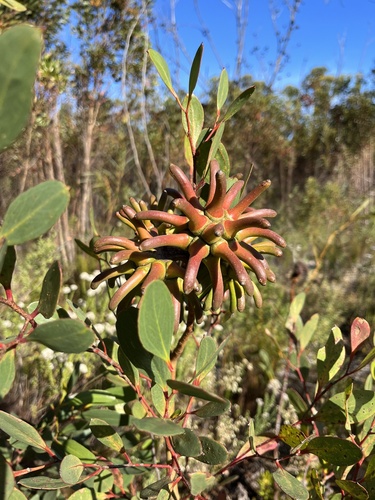
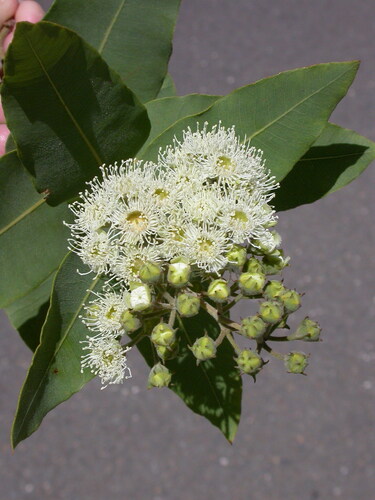
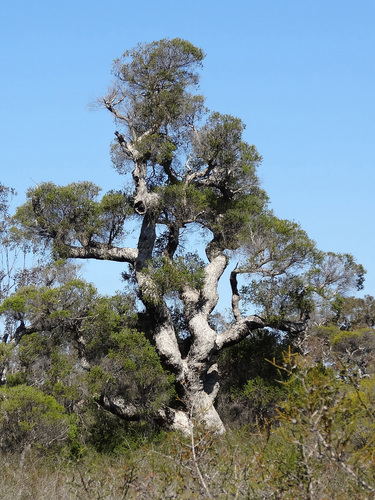
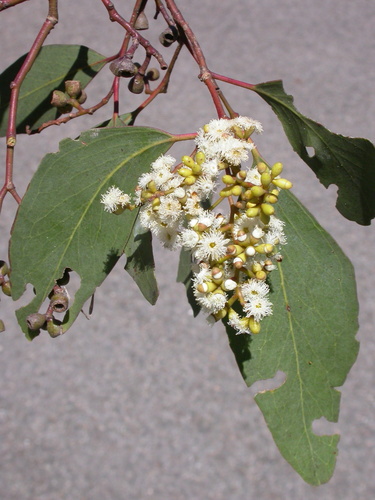
Eucalyptus behriana F.Muell. is a species of tree or mallee that typically reaches 12 metres (39 feet) in height, and forms a lignotuber. It has rough, fibrous, dark brown to black bark on the base of the trunk, and smooth greyish, greenish or coppery bark on the upper trunk and branches. Leaves on young plants and coppice regrowth are alternately arranged, egg-shaped, 50–105 mm (2–4 in) long, 25–65 mm (1–3 in) wide, and borne on a petiole. Adult leaves are also alternately arranged, broadly lance-shaped to egg-shaped, 45–130 mm (2–5 in) long and 13–50 mm (0.5–2 in) wide, carried on a 10–22 mm (0.4–0.9 in) long petiole, and are uniformly glossy green on both sides. Flower buds are grouped in clusters of seven, mostly born at branch ends on a 3–10 mm (0.1–0.4 in) long peduncle, with individual flowers usually being sessile. Mature buds are oblong to oval, green to brownish, 3–7 mm (0.1–0.3 in) long and 2–4 mm (0.08–0.2 in) wide, with a conical to rounded operculum. Flowering mainly occurs from September to February, and the flowers are white. The resulting fruit is a woody, cup-shaped or barrel-shaped capsule 3 to 6 mm (0.12 to 0.24 in) long and 3 to 5 mm (0.12 to 0.20 in) in diameter. This eucalypt has a disjunct distribution in south-eastern Australia. In New South Wales, it grows in mallee shrubland near West Wyalong. In Victoria, it is found in the Mallee and Wimmera regions of the north-west, apart from a small outlying population in the south near Bacchus Marsh that includes the Long Forest Nature Conservation Reserve. In South Australia, it has a scattered distribution across the south-east.