About Eucallipterus tiliae (Linnaeus, 1758)
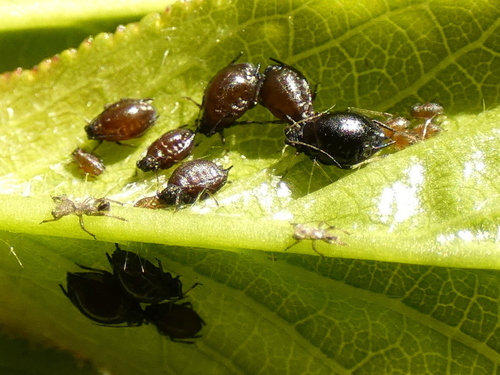
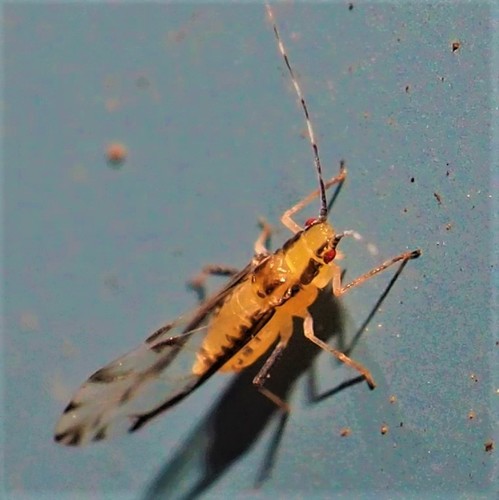
Eucallipterus tiliae, commonly called the linden aphid or lime-tree aphid, belongs to the family Aphididae. Though it is native to Eurasia, it can now be found worldwide anywhere species of Tilia grow. Adult individuals are easy to identify by a black stripe running along their body and a cloudy-black edge to their wings. These insects often colonize ornamental linden trees growing along streets and in parking lots. They leave a sticky residue called honeydew on the ground below infested trees, and encourage the growth of black mould on host tree leaves. Aphid numbers grow steadily through the host plant’s growing season, and large aggregations are common because the species is gregarious. Ten species of Ichneumonoidea, nine species of Chalcidoidea, various Coccinellidae, and Trioxys curvicaudus are recorded as parasitoids of this aphid. Where young and mature aphids feed on leaf surfaces depends on their stylet length: the short stylets of young aphids cannot penetrate the lignin in the sclerenchyma of large leaf veins, so young aphids are restricted to feeding on smaller veins. The antennae of this aphid are considerably longer than the body, often reaching the same length as the wings. They are setaceous and hairless, inserted close to the inner margin of the eyes at the front of the face, and made up of 7 segments. The two basal segments are stout and oblong, with the first segment being the stoutest. The remaining segments are more slender: the third segment is very long, the fourth is only half this length, the fifth and sixth are roughly the same length as each other, and the seventh is considerably shorter and more slender, with a small number of hairs at its tip. The feeding mouthparts (trophi) arise from the lower part of the face between the front pair of coxae. The labrum is short, broad, and roughly conical. The mandibles and maxillae are slender. The labium is bent under the insect’s breast and connected to the antepectus. In males, it is no longer than the head and rather stout, made up of short oblong segments. The second segment is the stoutest and curved, while the fourth is the smallest, ovate-conical, and covered in fine hairs; in females, the labium is longer and more slender. The head is immovable, and transverse-convex from a front view. The face is transverse-oval and strongly deflexed downward on the underside of the head. The eyes are globose, spaced apart, located on the sides of the head, and not very prominent. The ocelli are spaced apart: one sits near the inner margin of each eye, and the third sits close to the front margin of the forehead. The thorax is oblong, with a very long collar in males, and the scutellum is semi-circular. The abdomen is elongated-conical, and bears 2 tubercles or tubes on the fifth segment in males. In females the abdomen is always elongated, with a horny process under the tip. The wings are membranous, held deflected when the aphid is at rest. The forewings are twice as long as the body and broad, with short marginal furcate cells. The hindwings are much smaller, with two slightly oblique veins that are spaced apart along the costa. Most females of this species are apterous, meaning they do not have wings. The legs are slender and long, especially the hind pair. Both the thighs and tibiae are elongated in females, particularly on the hind pair, which are not curved. The tarsi are short and have two segments: the basal segment is very small, and the second is long and club-shaped. The tarsal claws are curved and sharp.