About Eubucco versicolor (P.L.S.Müller, 1776)
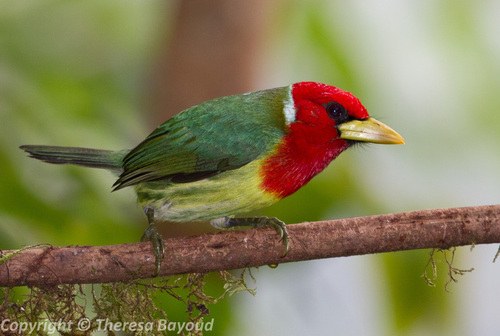
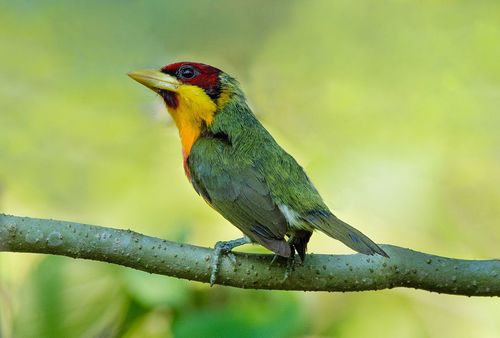
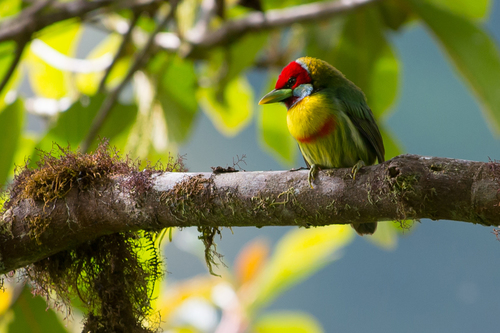
The versicolored barbet, Eubucco versicolor, is a multicolored bird that, like all barbets, has a sturdy bill. All subspecies are approximately 16 cm (6.3 in) long, but differ in weight and plumage. All males have a red face and crown, green to blue-green upperparts, red lower breasts, and yellowish bellies with green streaks; the size and shape of the red lower breast varies between subspecies. Females share the same green to blue-green upperparts and yellowish bellies with green streaks as males. The nominate "blue-moustached" form weighs 28 to 39 g (0.99 to 1.38 oz). Nominate males have a red throat with a thin blue band below it, a blue malar patch (the "moustache"), a blue band separating the red head from the greenish back, and a yellow upper breast. Nominate females have a greenish cap, blue malars with a yellow edge, and a blue throat with a thin red band below it. The "blue-cowled" form weighs 31 to 37 g (1.1 to 1.3 oz). Males of this form have blue back of the head and nape (the "cowl"), and a red chin, yellow malars, and yellow throat. Females of this form have yellow crown and nape, and blue face, throat, and upper breast, with a thin red crescent dividing the throat and breast. The "blue-chinned" form weighs 26 to 41 g (0.92 to 1.45 oz). Males of this form have a thin blue band behind the head like the "blue-moustached" form, a yellow malar, and successive bands of red, blue, and orange between the bill and the yellow upper breast. Females of this form have yellow crown and nape, and blue face and throat with a red band below the throat. The nominate "blue-moustached" barbet is distributed from Peru's Cuzco and Puno Regions eastward to Cochabamba Department in north central Bolivia. The "blue-cowled" form is found only in Peru, ranging from west central Amazonas south to northern Huánuco. The "blue-chinned" form is also found only in Peru, along the eastern slope of the Andes from eastern Huánuco to northern Cuzco. All subspecies of the versicolored barbet live in humid submontane forest, especially forests with heavy epiphyte and moss growth, as well as mature secondary forest. The nominate subspecies additionally inhabits dry forest in Bolivia. All three forms typically occur at elevations from 1,000 to 2,000 m (3,300 to 6,600 ft), and can be found as high as 2,225 m (7,300 ft).