About Eubucco richardsoni (G.R.Gray, 1846)
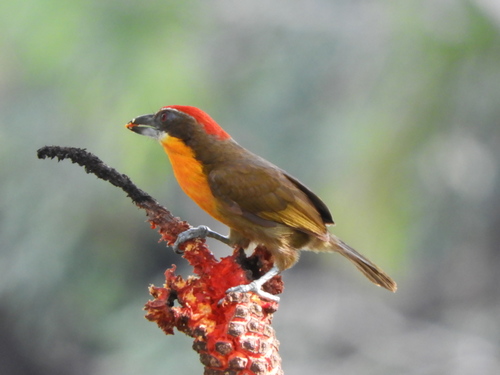
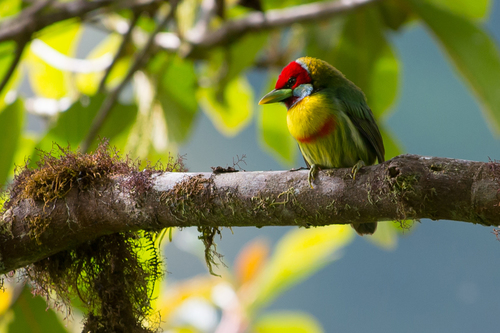
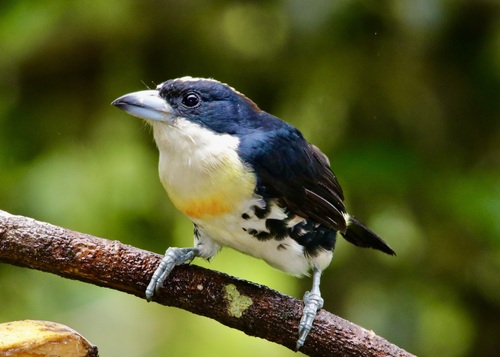
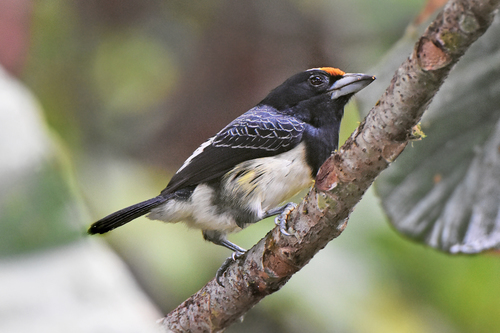
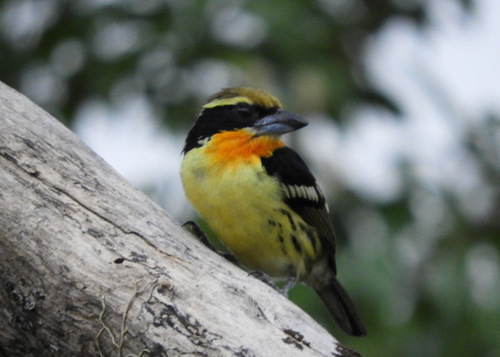
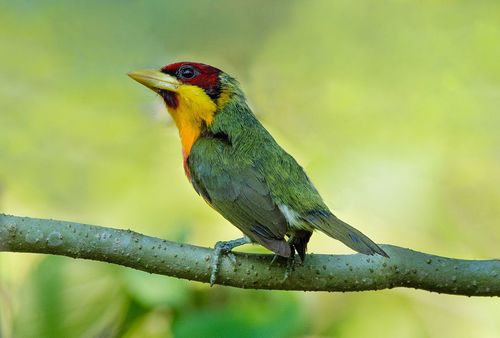
Eubucco richardsoni, commonly known as the lemon-throated barbet, has a described size range and distinct plumage that varies by sex and subspecies. The nominate lemon-throated barbet is approximately 15.5 cm (6.1 in) long and weighs 24.5 to 34 g (0.86 to 1.20 oz). Male nominate subspecies have a red crown, gray-blue nape, green upperparts, yellow throat, orange-red breast, and greenish belly and flanks marked with dark streaks. Females are duller overall, with gray-green crown, nape, and upperparts, a bluish throat, orange-gold breast, and bluish yellow underparts with dark streaks. The subspecies E. r. nigriceps has a black crown on males, and both sexes of this subspecies have blue-green upperparts. The subspecies sometimes called the flame-throated barbet measures 14.5 to 15.5 cm (5.7 to 6.1 in) long and weighs 26 to 42 g (0.92 to 1.48 oz), heavier than the other two lemon-throated subspecies. E. r. aurantiicollis differs from the nominate subspecies by having a yellow nape, yellower green upperparts, a more orange throat, and a redder breast; its female is similar to the nominate female but has less yellow on the throat and breast. Male E. r. purusianus are paler than nominate males and more pinkish on the breast, while the female's orange-gold breast band matches the nominate's but is narrower. This species is native to the western Amazon Basin, with each of its four subspecies occupying a distinct geographic range. E. r. richardsoni ranges from the Arauca Department of eastern Colombia south and east through eastern Ecuador into northern Peru, west of Iquitos. E. r. nigriceps occurs from the lower Putumayo and Napo Rivers in northeastern Peru east to far western Amazonas, Brazil, north of the Amazon River, with one additional recorded sighting further east in Jaú National Park. E. r. aurantiicollis is found from the Marañón River area in eastern Peru east to near the Juruá River south of the Amazon in western Brazil, and south to northwestern Bolivia. E. r. purusianus is found in western Brazil south of the Amazon, from the Juruá River area east to the upper Madeira River. All four subspecies share the same habitat preferences. They inhabit lowland terra firme forest, dense secondary forest, and the edges and clearings of these forest types. They also occur along the edges of várzea forest. They are more abundant in maturing forest near rivers and lakes than in fully mature forest. Their maximum elevation range varies by country: they occur from the lowlands up to 1,375 m (4,511 ft) in Colombia, 1,200 m (3,900 ft) in Ecuador, 1,100 m (3,600 ft) in Bolivia, and 1,000 m (3,300 ft) in Peru.