About Eubranchus exiguus (Alder & Hancock, 1848)
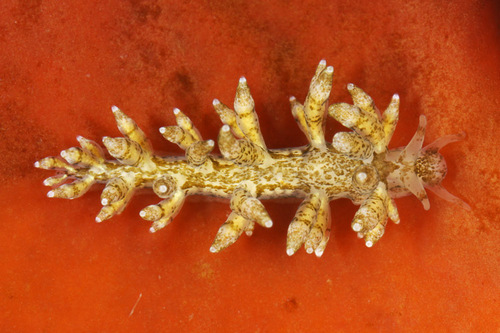
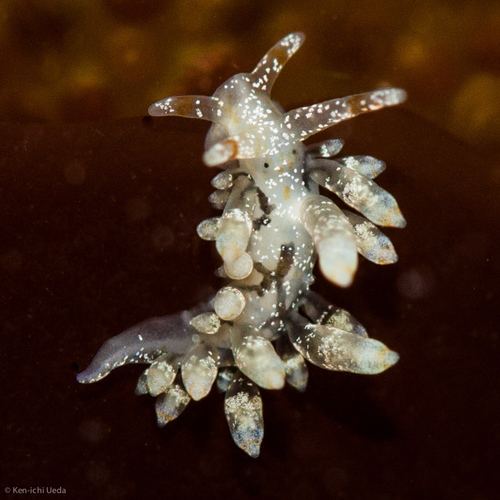
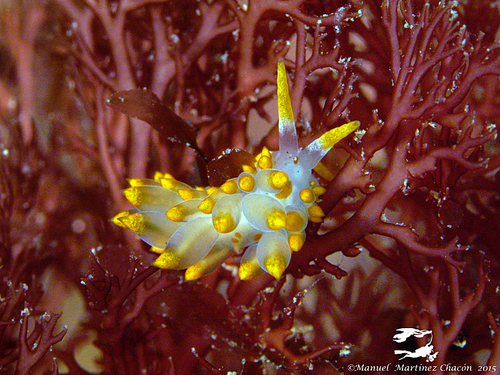
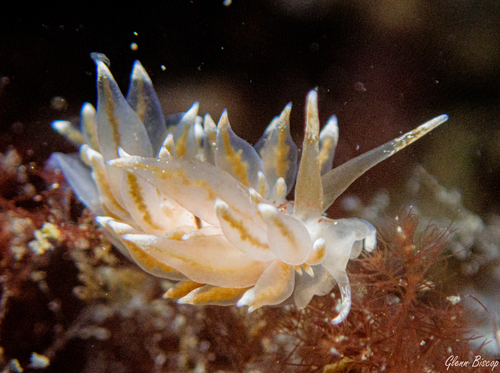
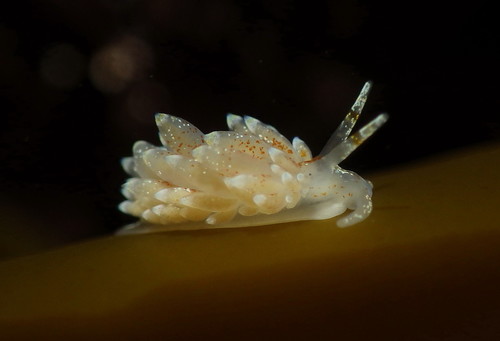
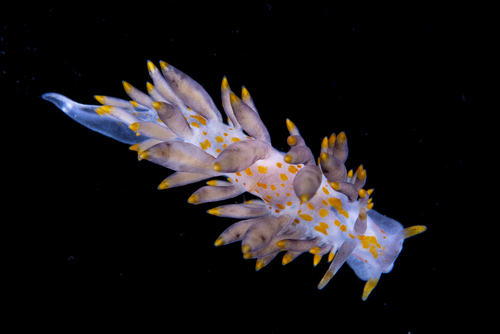
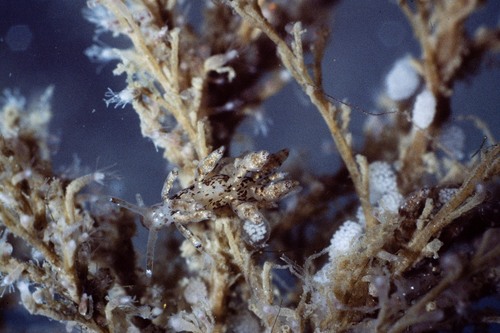
Eubranchus exiguus, originally described under the name Eolis exigua in 1848 by British malacologists Joshua Alder and Albany Hancock, matches the following original type description: Body is slender, yellowish white with olive or pale brown markings. Dorsal tentacles are linear and moderately long, with a brown ring near the top; oral tentacles are around one-third shorter and the same colour. Gills are generally arranged in a single series of five or six on each side, but fully mature specimens may have two on each side in front, or sometimes a cluster of three with the third positioned slightly behind the others. There is also often an extra papilla joined to some of the other gills behind. The gills are ovate, tapering abruptly to a point. They have a ring of olive or yellowish brown, sometimes reddish, a short distance from the apex, and often two other less distinct rings below, though these are usually only marked by brown spots or streaks. The body is also blotched and spotted with brown, and there is often an interrupted brown line on each side. The foot is rounded in front and nearly linear, with a thin pale brown margin along the sides. The length of the specimens described originally was 1½ to 2 lines. The maximum recorded length of this species is 8 mm. This species was first found in large numbers in Fowey Harbour, growing on Laminaria saccharina. Mr. Cocks also collected specimens at Falmouth. It is related to Eolis despecta, some specimens of which were found alongside Eubranchus exiguus, but it can easily be distinguished by the absence of the waved dorsal line that marks Eolis despecta. The original describers noted it appears to be the Tergipes lacinulatus documented by Professor Lovén, but they did not agree that it should be classified as the Limax tergipes of Forskahl, which is also called Doris lacinulatus by Gmelin. The type locality for this species is Fowey Harbour, England. It is found distributed all around the British Isles, and its range extends from the Arctic and Scandinavia south to the Mediterranean Sea. Its habitat has a recorded minimum depth of 0 m and a recorded maximum depth of 10 m.