About Eubalaena glacialis (Müller, 1776)
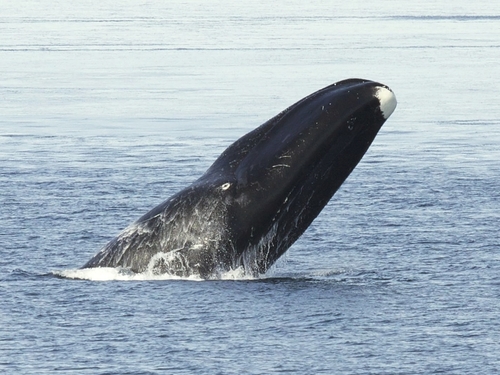
Like other right whales, the North Atlantic right whale — also called the northern right whale or black right whale — can be easily told apart from other cetaceans by several features: it has no dorsal fin on its broad back, short paddle-shaped pectoral flippers, and a long arching mouth that starts above the eye. Its body color ranges from dark grey to black, and some individuals occasionally have white patches on their stomachs or throats. Other unique traits include a large head that makes up one quarter of the animal’s total body length, a narrow tail stock compared to its wide fluke, and a V-shaped blowhole that produces a heart-shaped spout of water. The most distinct feature of right whales is their callosities: rough, white patches of keratinized skin that grow on their heads. These callosities host large colonies of cyamids, also called whale lice — small crustaceans that feed on the right whale’s skin, as they cannot survive in open water. The symbiotic relationship between cyamids and right whales exists but is not well understood by scientists. Callosities are not caused by external environmental conditions, and are already present on right whale fetuses before birth. That said, cyamids growing near the blowhole have been linked to chronic entanglement and other injuries; their presence in this area is used as a measure of individual health during visual health assessments. Adult North Atlantic right whales average 13–18 m (43–59 ft) in length and weigh around 40,000 to 90,000 kg (44 to 99 short tons), and are on average slightly smaller than the closely related North Pacific right whale. Each side of the upper jaw holds 200–270 narrow baleen plates, which are roughly 3 m (9.8 ft) long and covered in very thin hairs. The pectoral fin measures 1.7 m (5.6 ft) in length. The largest measured specimens have been 18.5 m (61 ft) long and weighed 106,000–108,000 kg (234,000–238,000 lb). Females of this species are larger than males. Up to 45% of a right whale’s total body weight is blubber; this high proportion of low-density blubber causes the whale’s body to float after death. There is little data on the lifespan of North Atlantic right whales, but it is thought to be at least 70 years, and closely related right whale species have been recorded living over 100 years. Current average lifespans are 45 years for females and 65 years for males. The age of a right whale can be determined by examining its earwax after death. The oldest recorded individual was sighted between March 24, 1935 and August 13, 1995, and is estimated to have been up to 70 years old. However, a 2024 study found the current average lifespan is only 22 years, with just 10% of individuals living longer than 47 years, a change assumed to result from shortened lifespans caused by commercial whaling. It is unknown how many distinct populations of North Atlantic right whales existed before commercial whaling began. Most studies have historically concluded there were two original populations: one in the eastern North Atlantic, and one in the western North Atlantic. Two alternative hypotheses have also been proposed: one claims a single super-population ranged across the entire North Atlantic, with mixing of eastern and western migratory routes occurring at relatively high latitudes such as the Denmark Strait; the other proposes three sub-populations: eastern, western, and central Atlantic, with the central stock ranging from Greenland’s Cape Farewell in summer to the Azores, Bermuda, and Bahamas in winter. Recent research indicates the Azores was likely a migratory corridor rather than a wintering ground for this group. Recent studies show modern eastern and western populations are genetically much more closely related than scientists previously believed. Like bowhead whales, North Atlantic right whale habitat can be dramatically altered by climate change. North Atlantic right whales are promiscuous breeders. Females give birth for the first time at age nine or ten, after a one-year gestation period. The interval between births has increased since the 1990s, and now averages three to six years. Newborn calves are 4.0–4.6 m (13–15 feet) long at birth and weigh approximately 1,400 kg (3,000 pounds).