About Eubalaena australis (Desmoulins, 1822)
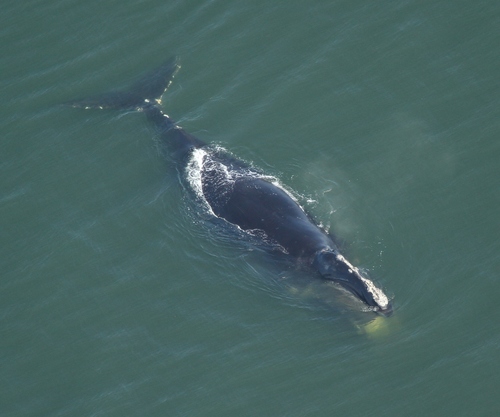
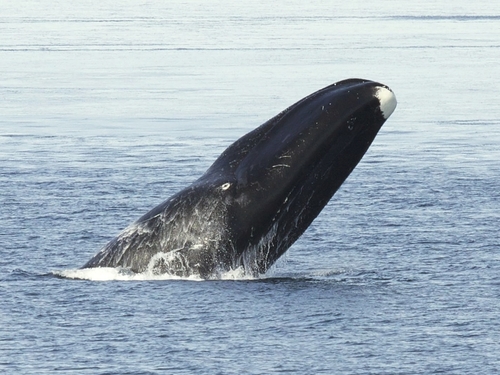
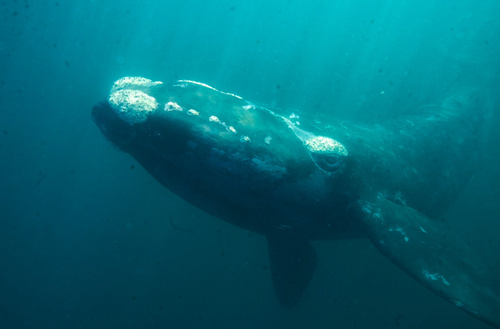
Like other right whales, the southern right whale (Eubalaena australis) is easily distinguished from other whales by callosities on its head, a broad back with no dorsal fin, and a long arched mouth that starts above the eye. Its skin is very dark grey or black, and occasionally has white patches on the belly. The callosities appear white because they host large colonies of cyamids, commonly called whale lice. This species is almost indistinguishable from its close relatives, the North Atlantic and North Pacific right whales, with only minor differences in their skulls. It may have fewer callosities on its head than North Atlantic right whales, and more callosities on its lower lips than both northern right whale species. The biological function of callosities is not clear, though protection from predators has been proposed as their primary role. Adult females measure 15 m (49 ft) in length and can weigh up to 47 tonnes (46 long tons; 52 short tons); larger recorded individuals reach 17–18 m (56–59 ft) in length and up to 80 tonnes (79 long tons; 88 short tons) in weight, making this species slightly smaller than northern hemisphere right whales. On each side of the upper jaw, there are 200–270 narrow baleen plates, approximately 3 m (9.8 ft) long and covered in very thin hairs. The pectoral fin is 1.7 m (5.6 ft) long. Right whales likely have the largest testicles of any animal, with each weighing around 500 kg (1,100 lb), which suggests sperm competition plays an important role in the species' mating process. The penis can reach a length of 2 m (6.6 ft). Compared to northern hemisphere right whale species, the southern right whale has a notable proportion and number of light (molten-coloured) individuals, and some individuals stay white even into adulthood. The oldest recorded southern right whale lived to 70 years of age, but a 2024 study found the median lifespan is around 73 years, with some individuals surviving to over 130 years. The global population of southern right whales was estimated at 13,611 in 2009. A 2008 National Geographic estimate placed the population at 10,000, while an estimate of 7,000 was produced after a March 1998 International Whaling Commission workshop. Researchers produced that 1998 estimate using population data from three 1990s surveys of adult females in Argentina, South Africa, and Australia. They extrapolated to account for unsurveyed areas, and used known male-to-female and adult-to-calf ratios to include estimates of males and calves. Overall population recovery is projected to remain below 50% of the pre-whaling population size by 2100, due to heavier historical impacts of whaling and slower population growth rates. Since hunting stopped, the population has been estimated to grow by 7% per year. Southern right whales spend summer feeding in the far Southern Ocean, likely close to Antarctica. They will feed in temperate waters when opportunity allows, such as off the coast of Buenos Aires. They migrate north in winter to breed, and can be seen off the coasts of Argentina, Australia, Brazil, Chile, Namibia, Mozambique, Peru, Tristan de Cunha, Uruguay, Madagascar, New Zealand, and South Africa; they are also known to winter in sub-Antarctic regions. South American, South African, and Australasian populations appear to have very little to no intermixing, because southern right whales have strong maternal fidelity to feeding and calving habitats, and mothers pass these habitat choices on to their calves. Right whales do not normally cross warm equatorial waters to connect with other right whale species or interbreed: their thick layers of insulating blubber make it hard for them to release excess internal body heat in tropical waters. Based on historical records and unconfirmed modern sightings, E. australis may sometimes pass through equatorial waters. Whaling records for the southern hemisphere note a whaling ground in the central northern Indian Ocean, and there have been recent sightings in near-equatorial regions. If the sighting off Kiribati was truly E. australis, the species may cross the Equator on irregular occasions, and its original distribution may have been much broader and extended further north than currently believed. A 21.3 m (71 foot) right whale stranded at Gajana, northwestern India, in November 1944 was reported, but the true identity of this animal is unclear. Beyond human-caused impacts to whales and their environments, the distribution and habitat use of southern right whales may be largely affected by the presence of natural predators, and similar trends are likely for other right whale subspecies. Many locations across the Southern Hemisphere are named after current or historical presence of southern right whales, including Walvis Bay, Punta Ballena, Right Whale Bay, Otago Harbour, Whangarei Harbour, Foveaux Strait, South Taranaki Bight, Moutohora Island, and Wineglass Bay. Southern right whales show strong maternal fidelity to their calving grounds. Calving females are known to return to calving grounds at 3-year intervals; the most common calving interval is 3 years, but intervals can range from 2 to 21 years. Calving occurs between June and November, in calving grounds located between 20 and 30° S. In Australia, southern right whales prefer calving grounds along coastlines with high wave energy, such as the Head of the Bight. The sound of breaking waves at these locations may mask the whales' presence, protecting calves and calving females from predators such as killer whales. Deep waters adjacent to shallower calving grounds may act as training grounds for calves to build up stamina before migration. Southern right whales reach sexual maturity between 3 and 6 years of age. Females give birth to their first calf when they are between eight and ten years old. A single calf is born after a one-year gestation period, weighing around 1 short ton (0.91 t) and measuring 4–6 m (13–20 ft) in length. The calf usually stays with its mother for the first year of life, during which time it doubles in length. One southern right whale with sex chromosome aneuploidy (XXY) has been reported. Southern right whales have been observed nursing unrelated orphan calves on occasion. Male-to-male sexual penetration has been observed in southern right whales; this behaviour has been attributed to multiple possible explanations: socialization, play, and reducing tension between males.