About Euaresta aequalis (Loew, 1862)
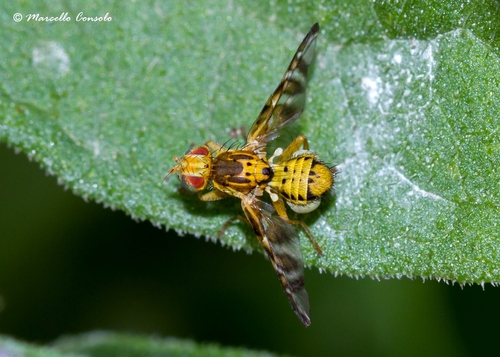
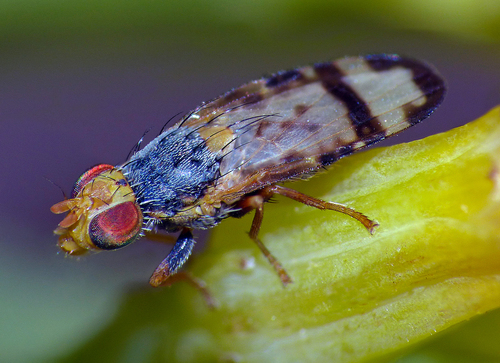
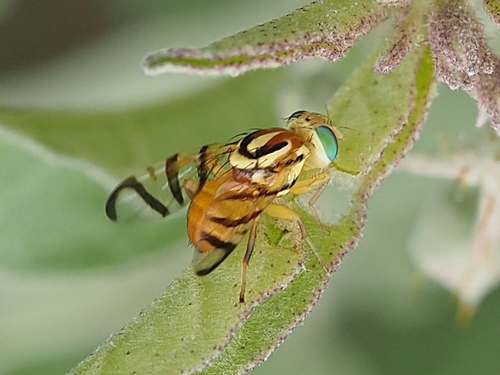
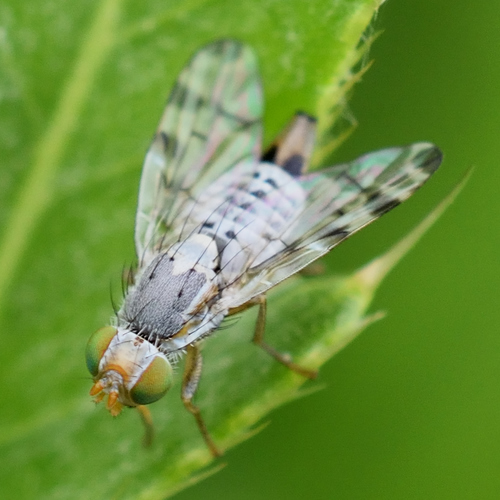
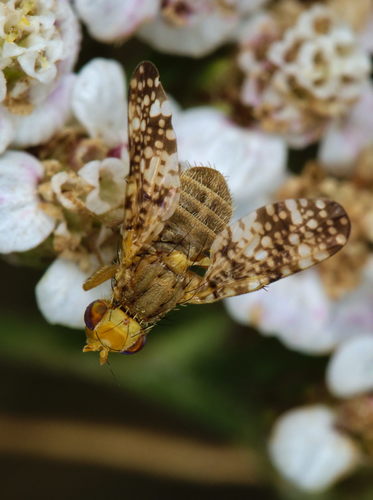
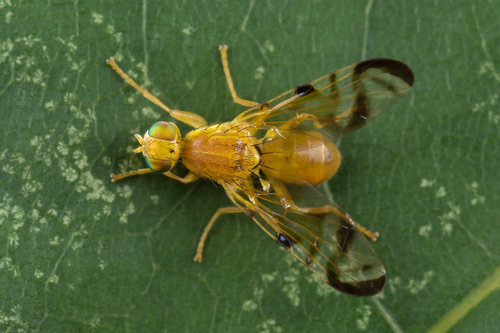
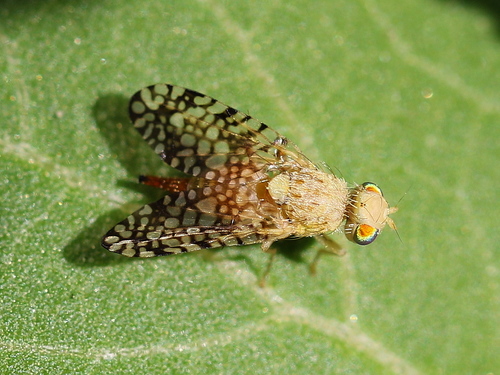
Euaresta aequalis (Loew, 1862), commonly known as the burr-seed fly, belongs to the family Tephritidae. Like other members of this family, it has elaborate wing markings, and it also has distinctive brilliant green eyes. Its diagnostic species features include a tan or yellow body, and a clear round spot on the wing in cell r4+5 that is separated from the wing margin by a distinct brown band. Among all North American species of the genus Euaresta, only E. aequalis and E. festiva do not have a dark brown to black base body color. This species is generally the largest of all North American Euaresta.
This species is widely distributed across the United States and southern Canada. It was first recorded in Mexico’s Baja California in 1969. It was introduced to Australia in the 1930s as part of a biological control effort targeting invasive cocklebur. Noogoora burr, a variety of Xanthium, was introduced to Australia in the 1920s, most likely imported from the southern United States. It rapidly spread and became a widespread problem, particularly harming the wool industry: the burrs would become caught on grazing sheep and were extremely difficult to remove. E. aequalis was selected as a candidate for biological control of Noogoora burr, alongside two stem-boring beetles and a tortricid moth. The first releases of E. aequalis took place in Queensland in 1932. While the species established at low population levels in Australia, it was not effective at controlling Noogoora burr. This is because E. aequalis larvae typically only attack one of the two seeds contained in each Noogoora burr fruit. Noogoora burr was eventually controlled by an accidentally introduced rust fungus.