About Etiella behrii (Zeller, 1848)
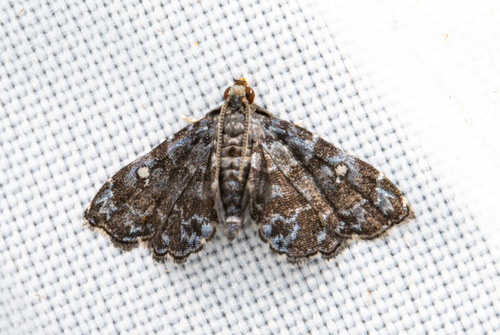
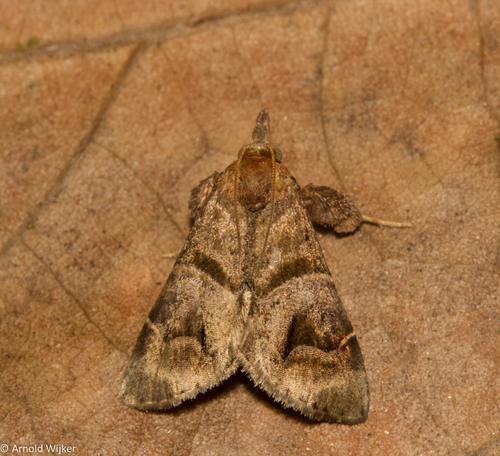
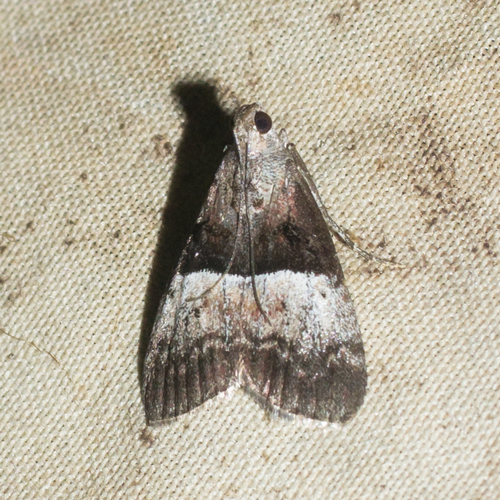
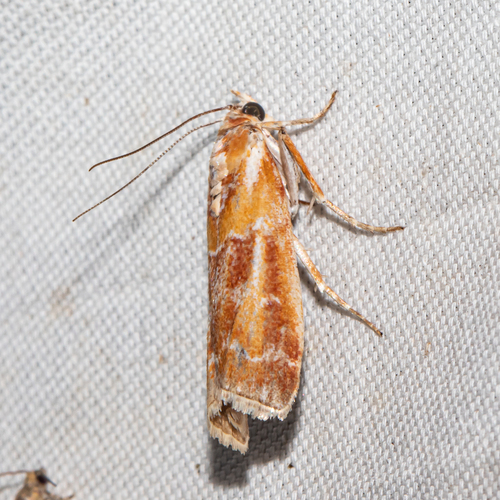
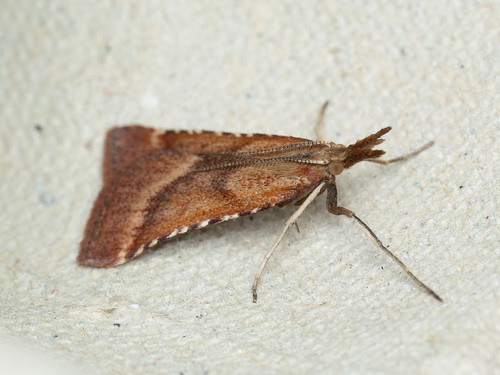
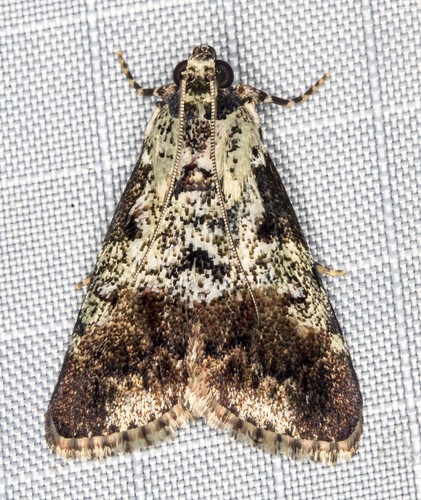
Etiella behrii (Zeller, 1848), commonly called the lucerne seed web moth, has distinct life stage characteristics. Early instar larvae are pale green with a mottled brown head and pink markings. As caterpillars mature, they become more pink and their stripes turn red. Fully grown larvae reach up to 12 mm (0.47 in) in length, with a dark brown head capsule, four pairs of abdominal prolegs, and one anal proleg. Eggs are oval, clear or off-white, and turn orange before hatching. When at rest, adult moths have a long, slender body shape. They have a protruding beak, and are brown or grey overall. Their forewings bear a brown pattern, a transverse orange stripe near the base, and a white line along the leading edge (costa). Hindwings have brown veins through satin-textured beige or white tissue, with a dark brown outer edge. Males have knobs at the base of their antennae, and the adult wingspan is about 10 mm (0.39 in).
Etiella behrii is distributed across much of Southeast Asia, including Hong Kong, Indonesia, and Malaysia. It is found across most of Australia, specifically occurring in the Northern Territory, Queensland, New South Wales, the Australian Capital Territory, Victoria, and Western Australia. More recently, the species has been recorded migrating 250 km (160 mi) across the Bass Strait to Tasmania; detections here coincide with the arrival of other known migratory species after air conditions suitable for migration across the strait develop. It is theorized that E. behrii cannot breed and establish a permanent population in Tasmania, due to a lack of winter diapause and the absence of observed larvae in the region.
Both adults and larvae of E. behrii feed on at least six native and 18 introduced legume species, including plants in the genera Lens, Lupinus, and Medicago. It is considered a serious but sporadic pest of lucerne (alfalfa, Medicago sativa) seed crops in South Australia. Larvae are also agricultural pests on other leguminous crops, including peanut (Arachis hypogaea), Chamaecytisus prolifer, sky lupine (Lupinus nanus), pea (Pisum sativum), and soybeans (Glycine species).
Shortly after hatching, larvae bore into green seed pods, leaving visible pin-holes. During early development, a single larva only damages one seed pod. Larvae first feed internally inside the seed pod, then switch to external feeding on seeds within the pod. Mature larvae web together multiple seed pods to continue feeding. The species is thought to live on native plants in scrubland and along roadsides during spring and early summer, before moving to infest lucerne seed crops in January. Most infestations are minor and can go unnoticed, but occasional very heavy infestations occur in a single season. The cause of sporadic widespread E. behrii infestations in lucerne crops is not well understood. Multiple factors are thought to influence annual infestation size, including crop planting timing, scarcity of native host plants, and the presence of natural enemies. Early-planted lucerne crops are observed to be more likely to experience heavy infestations than late-planted crops. The abundance of predators and parasites can reduce larval populations in mid to late January, a period when lucerne crops hold large numbers of green seed pods suitable for larval development. Ten species of parasitic wasps and flies, two pathogens, and several predatory insects have been recorded attacking lucerne seed web moth larvae.