About Etheostoma whipplei (Girard, 1859)
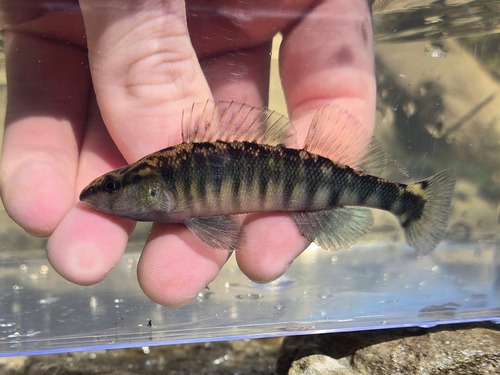
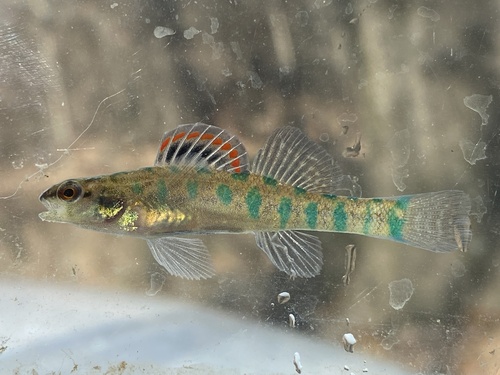
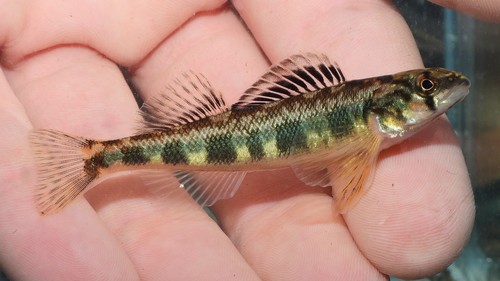
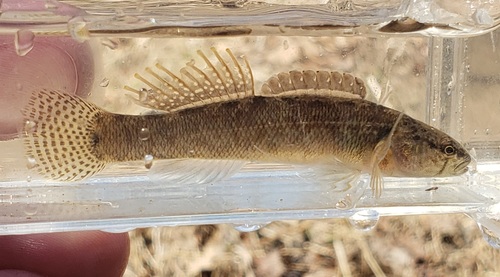
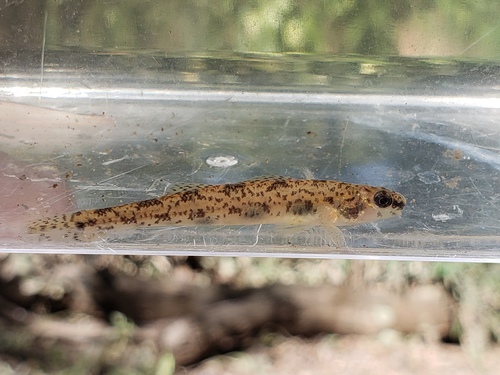
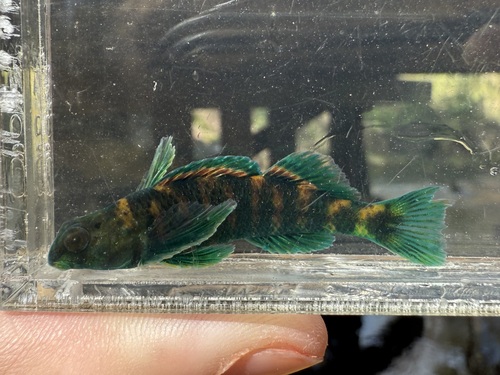
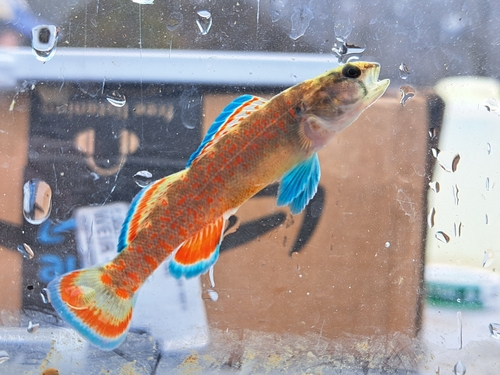
This species is scientifically named Etheostoma whipplei (Girard, 1859), and is commonly called the redfin darter. The redfin darter can grow to a maximum length of 9.0 cm (3.5 in), though most individuals only reach around 5.5 cm (2.2 in). Females and juveniles are grayish and mottled, with 8 to 10 vague dark saddles along their backs. Their snouts are slightly pointed, and their lips are dark. Prominent suborbital bars extend above, behind, and in front of the eye, forming a cross shape that passes through the eye. The bar in front of the eye nearly connects to the matching bar on the opposite side of the upper lip, creating a spear-like pattern when the fish is viewed from above. This species has an incomplete lateral line, and the skin on its cheeks and breast appears naked (lacking scales). Breeding-colored males display bright red spots along their sides; these spots may be less vivid and distinct in some specimens found in central Louisiana. Males also have red spots on the basal interradial membranes of their spinous dorsal fin. The spinous dorsal fin has a broad golden area, followed by a bright red submarginal band, with a deep blue band along the fin’s outer margin. The anal fin has a red base, and its margins share the same vivid deep blue color seen on the dorsal fin margins. The redfin darter’s main habitat is gravel or rubble riffles in small rivers, but in Louisiana and Mississippi, this species is associated with aquatic vegetation. The redfin darter’s spawning season lasts between 2.7 and 3 months, running from February to May each year. Females produce clutches containing 31 to 207 eggs. Males of this species reach breeding condition earlier than females, and adult males are larger than adult females. Mature eggs have an average diameter of 0.89 to 1.18 mm, while fully ripe eggs have an average diameter of 1.17 to 1.27 mm. Breeding males of the redfin darter have bright red and blue coloring on their fins and bodies, similar to that seen in the Gulf darter, Etheostoma swaini.