About Etheostoma variatum Kirtland, 1840
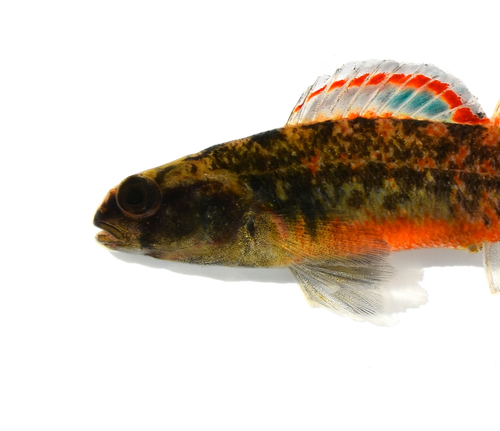
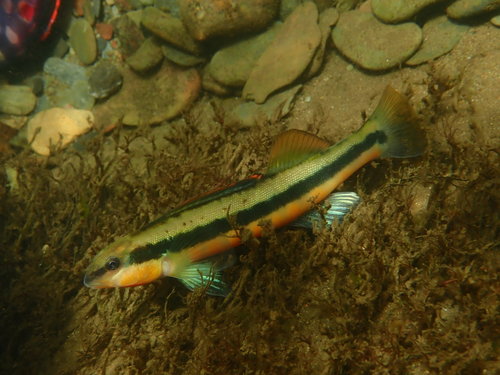
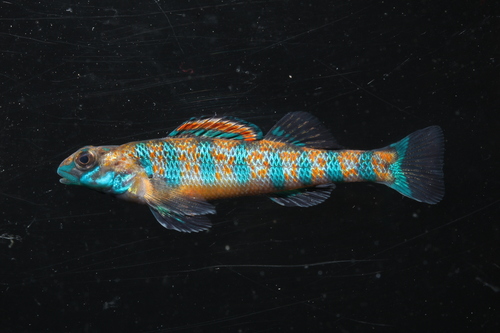
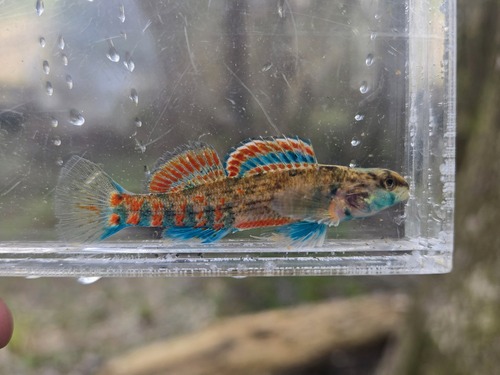
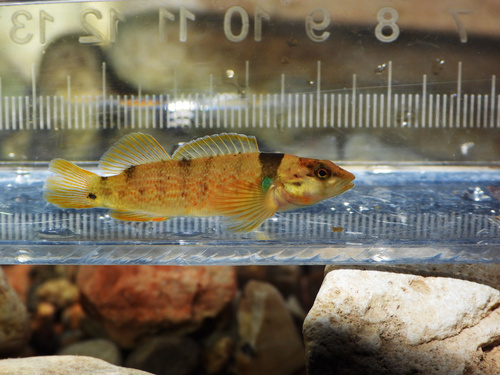
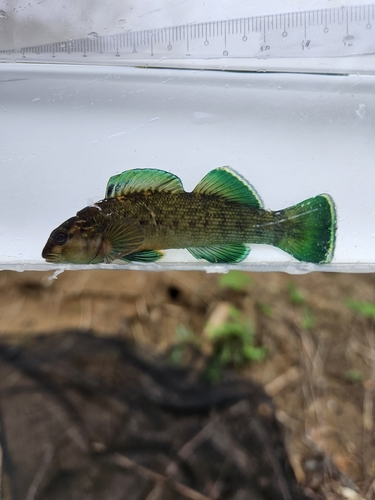
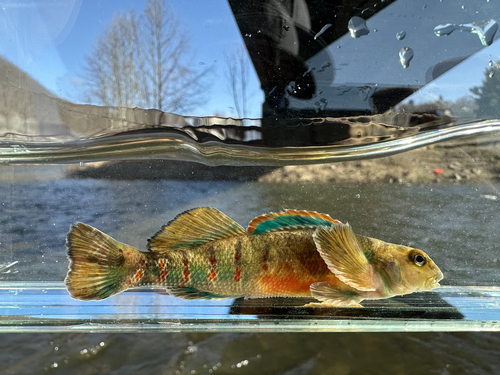
Etheostoma variatum, commonly called the variegate darter, is large for its family, with an average length between 2.5 and 3.5 inches (6 to 9 cm). It displays a wide range of distinct markings. Its dorsal fin has a red-orange band, followed by a blue-green band, and a red-brown band along the fin’s edge. Red spots are also present on all of its other fins. This darter has large pectoral fins that it uses to stay upright in the fast-moving water of its habitat. It has four to six dark, saddle-shaped markings along its back; three to four of these saddles are typically dark and clearly visible, while the rest are not. Etheostoma variatum inhabits small and medium-sized rivers and streams, most often in riffles made up of small rocks. It tends to occupy the fastest-flowing riffle sections of these waterways. It requires rivers and streams with high water quality to survive, so it is often considered an indicator of good water quality. Its range is centered primarily in the U.S. states of Ohio, New York, Pennsylvania, Indiana, West Virginia, and Kentucky; it has also been found rarely in Virginia. Reproduction takes place in early spring, from April to May. During this time, males establish dedicated spawning territories. After spawning, females lay their eggs in riffles and bury the eggs under pebbles. Once the eggs are buried, the parents abandon them.