About Etheostoma stigmaeum (Jordan, 1877)
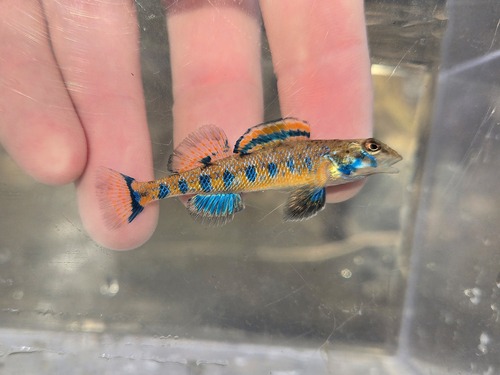
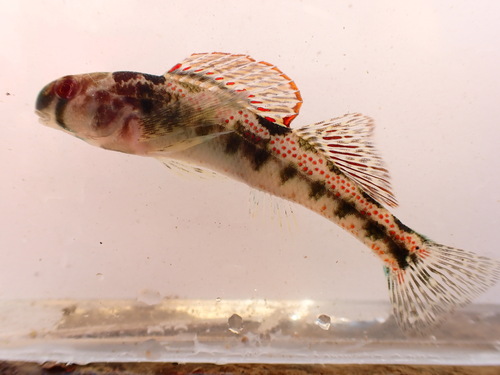
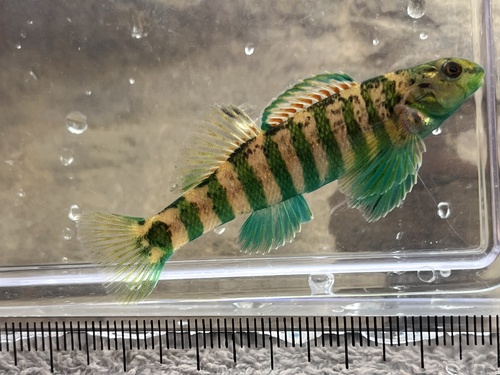
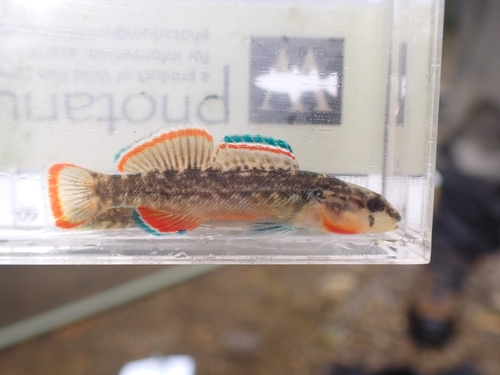
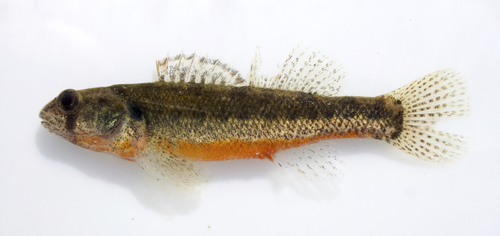
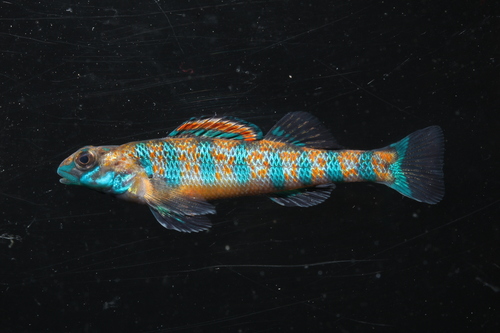
Etheostoma stigmaeum, commonly called the speckled darter, is a species in the family Percidae. This fish has a moderately blunt snout and lacks a premaxillary frenum. It reaches a maximum total length of approximately 2.2 inches. Speckled darters have both fin spines and fin rays, an incomplete lateral line, and gill covers that are slightly connected by a membrane stretching across the throat. The midline of the belly has no enlarged scales. Their dorsal side is sandy in color, while their ventral side is yellow or white. Six dark brown saddles and large specks mark the dorsum, and 7 to 11 dark brown blotches run along the length of the body. Males in breeding condition develop turquoise bands on their sides and fins, instead of the species' typical dark blue coloration. Breeding females are far less brightly colored than breeding males, and they develop an extended genital papilla. The speckled darter is a freshwater fish. It prefers clear, up to 1 meter deep pools in moderately swift streams, and it typically lives over bottoms made of sand, or a mix of sand and gravel. This species is distributed across eastern Oklahoma, southeastern Kansas, western Louisiana, Virginia, northwestern Georgia, and western Florida; it also occurs in Gulf of Mexico drainages from the Sabine River to Pensacola Bay. In Missouri, spawning occurs as early as March and as late as May, when water temperatures range between 57°F and 62°F. Females bury their eggs in the substrate. Incubation period is correlated with water temperature: higher temperatures reduce the length of incubation. At temperatures between 62°F and 68°F, the typical incubation period lasts 9 to 10 days. Larvae hatch at a length of 4.2 to 5.2 mm, with a functional jaw and well-developed pectoral fins.