About Etheostoma microperca Jordan & Gilbert, 1888
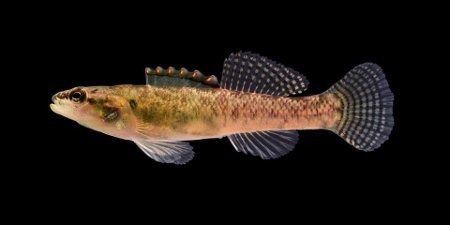
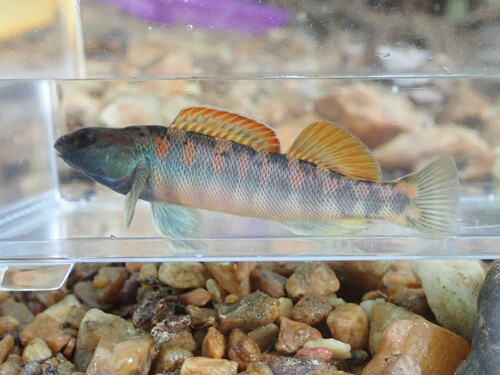
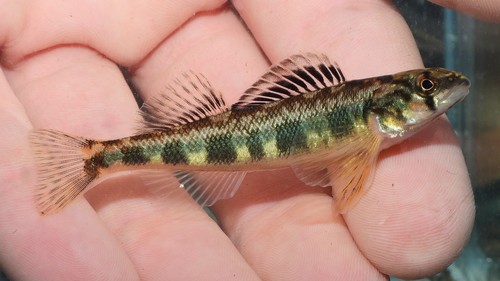
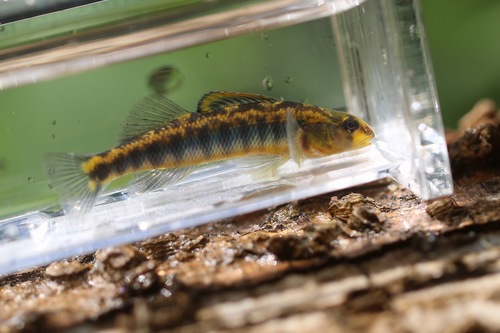
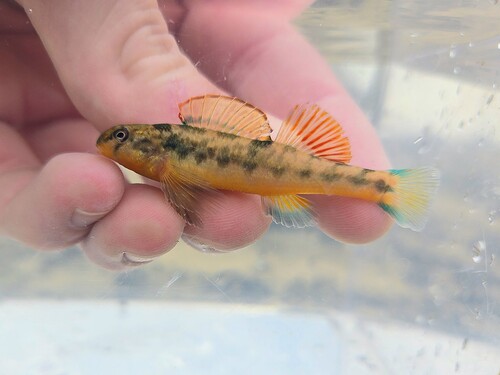
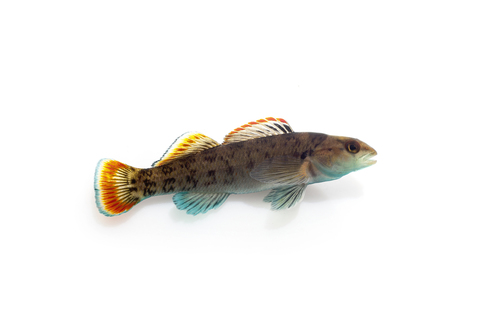
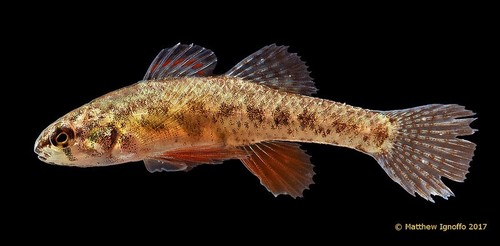
Etheostoma microperca, the least darter, is a very small fish, typically measuring 25–35 mm (1–1 3/8 inches) in length, with a maximum recorded length of about 45 mm (1 3/4 inches). The species has an overall base color of light olive brown, covered in darker brown speckles. Its lateral line is often absent; when present, it is very short. Seven to 15 dark blotches run along the fish’s sides, and each blotch is wider than it is tall. The second dorsal fin and tail fin have many small dark spots arranged into wavy rows. E. microperca also has a distinct teardrop-shaped spot under each eye, and often several other dark lines radiate outward from the eyes across the head and snout.
Breeding males have a band of red spots across the middle of their first dorsal fins. Males also have oversized pelvic fins, and their pectoral, pelvic, and anal fins are flushed with orange or red. Females are very similar in appearance to males, but lack any red or orange coloration and have smaller pelvic fins; their fins are spotted and lightly pigmented.
The species has a fusiform to cylindrical, slightly elongated body shape that is slightly laterally compressed toward the anterior end, and is round to oval in cross section. As a perciform teleost, it has ctenoid scales, where the posterior exposed portion of each scale bears tiny tooth-like projections called cteni. This species has 32–38 ctenoid lateral scales. All of its fins, including the tail and dorsal fins, are rounded or squared. The dorsal fin has two slightly separated lobes: the first lobe has five to seven spines, and the second has 9–10 soft rays. The pelvic fins are positioned on the thorax, and the anal fin has one or two spines and five or six rays.
As these fish lack swim bladders, their pectoral fins may function in vertical movement, low-speed maneuvering, braking, and maintaining position in strong currents. Because of these multiple functions, pectoral fin length is an unreliable indicator of habitat for bladderless darters like this species.
Etheostoma microperca is distributed across the northeastern United States, particularly in the Midwest. It is counted among the 324 fish species found in Tennessee, and has also been recorded in states including Minnesota, Illinois, Ohio, and many others. As of 2008, it had been documented at a limited number of sites across the southern two-thirds of Minnesota, with most populations occurring in the west-central portion of the state, in the Otter Tail River and upper Mississippi River drainages.
Adult E. microperca are usually found in streams near vegetation, such as along overhanging grassy banks and among filamentous algae. Juveniles are mainly found in thick algal growth along stream edges. These fish are rarely found in midstream or away from vegetation, and live exclusively near stream edges in quieter water to avoid strong currents. They also primarily reside in natural lakes and permanent wetlands that hold large amounts of aquatic vegetation and clear water.