About Etheostoma histrio Jordan & Gilbert, 1887
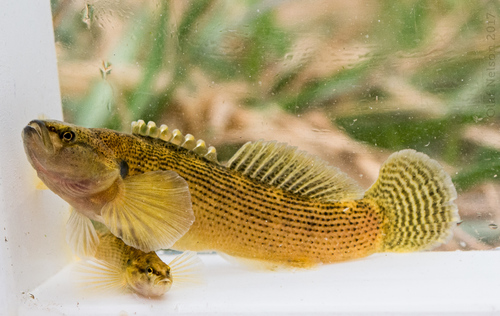
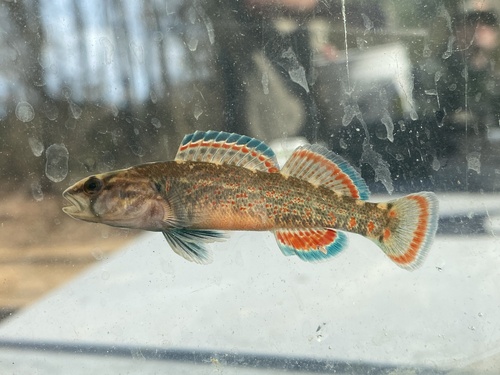
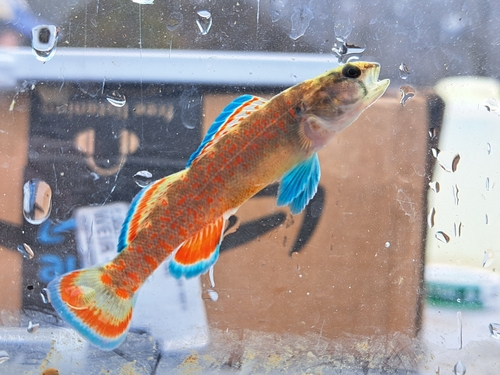
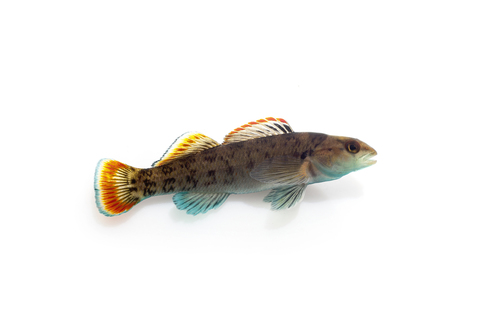
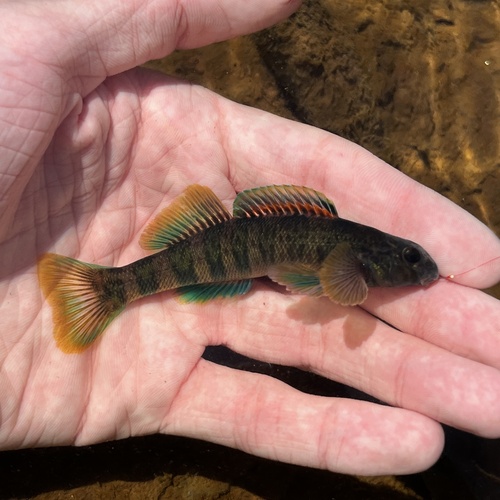
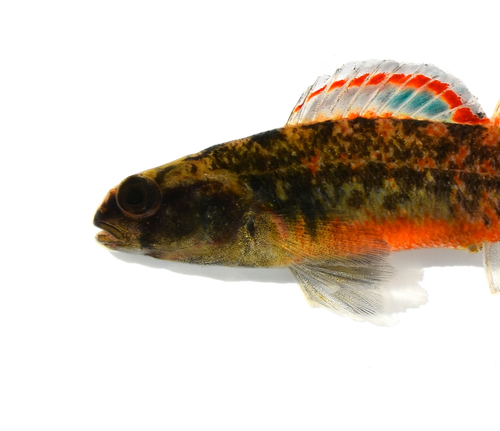
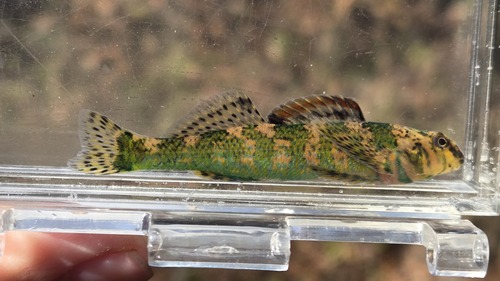
Etheostoma histrio, commonly called the harlequin darter, can grow to a maximum total length of 7.7 cm (3.0 in), though most individuals only reach around 5.3 cm (2.1 in). Its sides are green, with six or seven brown saddle-shaped markings along the top of its body. The belly is typically yellow or tan with dark blotches, and the base of the caudal peduncle and the caudal fin have a distinct B-shaped marking. The first dorsal fin is clear with a red edge, while all other fins are mostly dark and covered in many dark blotches. Males and females have similar appearance outside of the breeding season; during breeding season, males show much brighter green coloration than females. This species does not develop nuptial tubercles. The common name harlequin darter comes from the mask-like pigmentation on its face, which includes a suborbital bar and dark blotching across the head, breast, and body. The harlequin darter was first documented in the Ouachita River of Arkansas and the Poteau River of Oklahoma. Its known geographic range has since expanded to cover most of the Southeast and the tributaries of the lower Mississippi River, extending from Illinois in the north, south to Florida, and west to Texas. Most of the species' population lives south of the Fall Line, but the northernmost recorded specimen was found in the Embarras River, a tributary of Illinois' Wabash River. In Tennessee, the harlequin darter only occurs in western parts of the state, within the Mississippi River and tributaries of the western Tennessee River. The full extent of the species' range is thought to be underestimated, because of its preferred habitat. The harlequin darter lives in large, fast-moving water bodies with abundant woody debris, which requires special sampling methods and leads to high sampling error. The species was removed from Indiana's endangered species list after previously unknown populations were discovered, and known populations in Indiana's Wabash River drainage have grown noticeably. In Florida, the harlequin darter is only found in the Escambia watershed; its limited occurrence in the state makes it especially vulnerable to catastrophic events in this restricted range. The construction of dams in Alabama has further isolated this Florida population from other nearby groups. While the harlequin darter has a fairly wide overall distribution, it is mostly uncommon across its range. The harlequin darter feeds on benthic invertebrates, including midge, caddisfly, mayfly, and blackfly larvae. Ecological specialization is a leading cause of the high diversity seen among darters. Across its range, the harlequin darter prefers moderate- to fast-flowing riffles with relatively high water quality, but it is set apart from other darters by its dependence on detritus and downed woody debris. It is one of the few darter species consistently found in the main channel of the Mississippi River, and it usually avoids smaller streams. Agricultural runoff often accumulates in these large water bodies, greatly raising nitrate and phosphate levels and creating unfavorable conditions for the harlequin darter. In addition, companies operating along these larger water bodies often remove vegetation and woody debris from riparian zones, which causes further harm to harlequin darter populations.