About Etheostoma fusiforme (Girard, 1854)
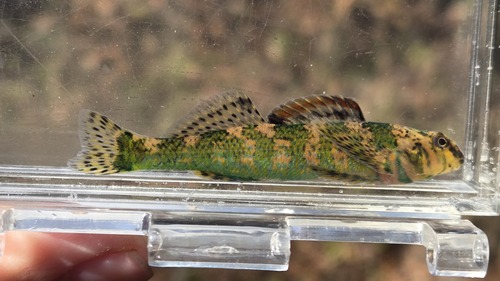
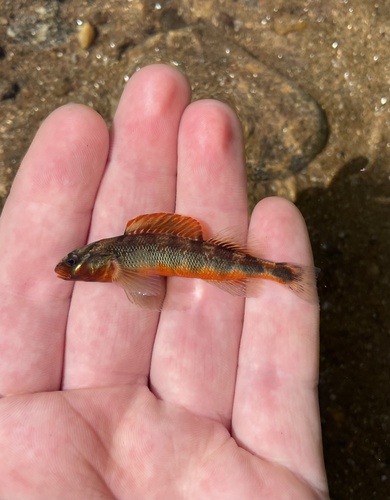
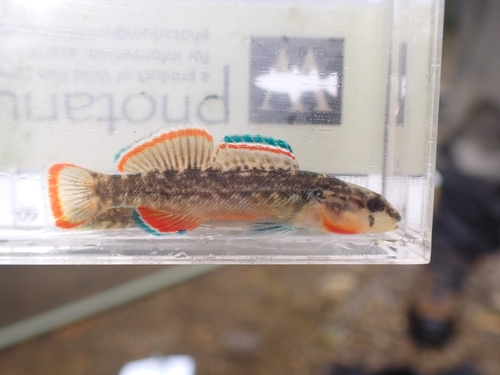
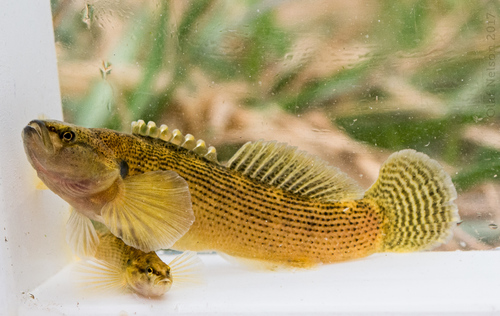
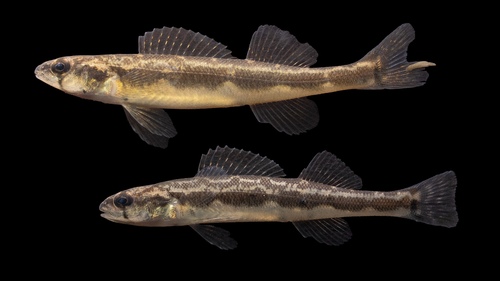
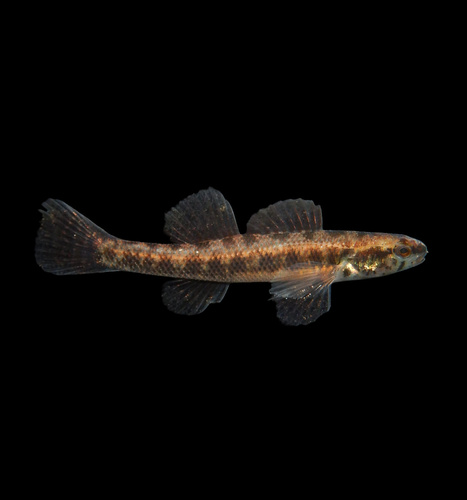
Etheostoma fusiforme, commonly known as the swamp darter, is a fish species first described by Girard in 1854. This species reaches a maximum total length of 5.9 cm (2.3 in), with most adults growing only to around 4 cm (1.6 in). It has a narrow, laterally compressed body, a rounded head, and a blunt, conical snout that does not extend past the upper lips. Its lateral line curves slightly upward toward the tail. The dorsal (upper) side of the body ranges from green to tan, marked with small dark saddle-shaped patches and dark green and brown mottling. There are 10 to 12 square-shaped markings along the flanks. The underparts range from white to yellow, covered with numerous black and brown speckles. A narrow suborbital bar is present, and three dusky black spots mark the caudal fin. Fin rays are marked with small spots; the spiny section of the male's dorsal fin typically has a dark band at its base, plus a second dark submarginal band. During the breeding season, males darken in color, and tubercles develop on the soft rays of the pelvic and anal fins, the spine of the pelvic fin, and often on the second spine of the anal fin. The swamp darter has a wide distribution across lowlands of the eastern United States. It generally occurs below the fall line on the Atlantic and Gulf coastal plains, ranging from southern Maine to Louisiana's Sabine River and the Red River of the South in southeastern Oklahoma. It is also found in Mississippi River tributaries as far north as Kentucky and southeastern Missouri. An introduced population of swamp darters is established in North Carolina's French Broad River system. In New York State, the species only occurs in the Peconic River and a small number of nearby ponds on eastern Long Island. It extends up the Red River of the South drainage as far as North Texas and southeastern Oklahoma, where it is rare. No other darter species is found as far south as Etheostoma fusiforme. The swamp darter inhabits slow-moving and still waters, such as ditches and oxbow lakes, that are typical of low-lying coastal plains. It prefers clearer, more vegetation-rich areas than the sympatric slough darter (Etheostoma gracile). Though it can occur in flowing water, it favors still habitats including backwaters, ponds, and areas behind beaver dams. It is most commonly found in dark acidic waters, but can thrive in clear water if sufficient cover is available. Swamp darters feed on fly larvae, amphipods, and other small crustaceans and insects. Where they co-occur, swamp darters are an important component of the diet of young chain pickerel and young largemouth bass. In New Jersey, spawning is thought to occur in May; breeding individuals have been collected in March, April, and May across other parts of the species' range. Swamp darters are not wary when spawning, and typically breed within the same habitats they occupy for the rest of the year. The male approaches a female from behind, mounts her, and beats her with his pelvic fins. The female then leads the male into aquatic vegetation, where eggs are deposited one at a time on plant leaves. No parental care for eggs has been observed, and no data exists on how many mates each sex typically has. Males do not typically fight or display territorial behavior during breeding. For most swamp darter populations, the maximum longevity is only one year, with very few individuals surviving to two years of age.