About Etheostoma exile (Girard, 1859)
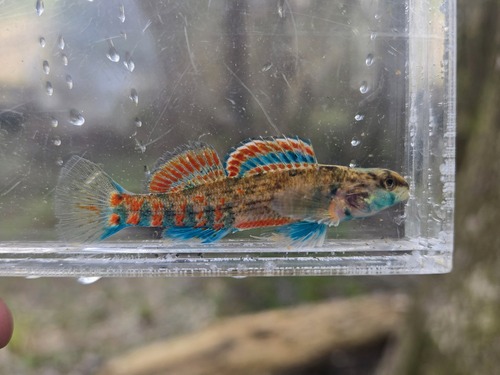
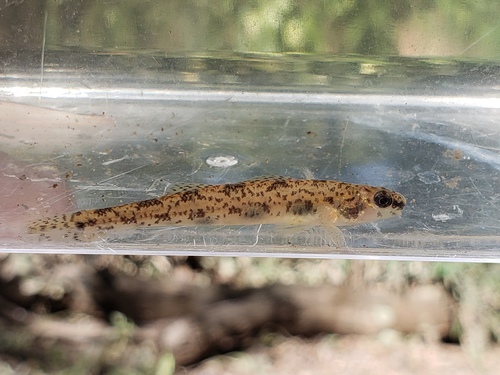
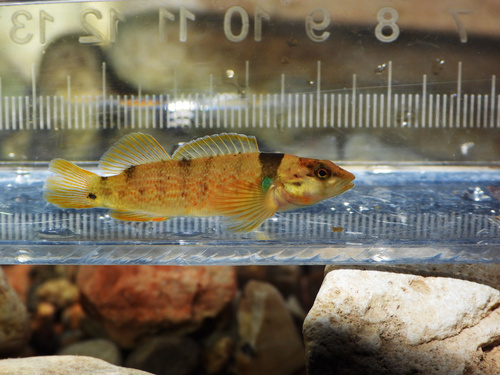
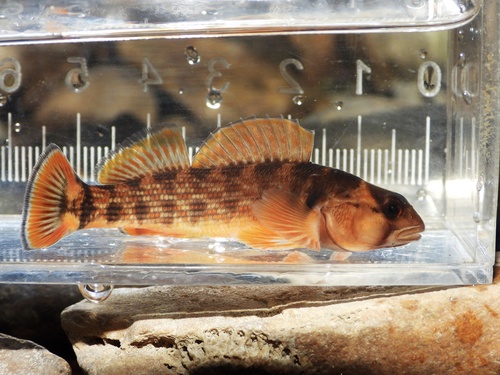
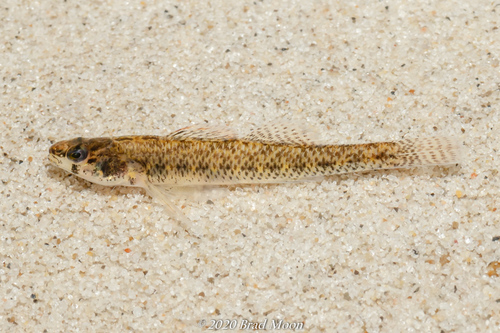
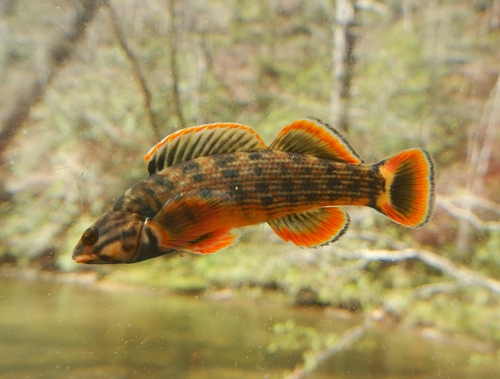
The scientific name of the Iowa darter is Etheostoma exile (Girard, 1859). It has a very slim, small body, with a common length around 5.5 cm, and a maximum age of three years. It has a small mouth and small snout, with scaled opercles and cheeks. It has two dorsal fins: one with spinous rays, and one soft-rayed. Its caudal fin is squarish, and the pectoral and pelvic fins are positioned close to each other behind the gills. It has an anal fin with two spines, rarely one, and an incomplete lateral line. Male and female Iowa darters have distinct color patterns. During breeding season, breeding males are olivaceous on the dorsal side, with darker splotches across their upper backs. Their sides are red with blue rectangular blotches, and their ventral side is whitish. They also have a dark wedge-shaped marking below the eyes. On the spiny dorsal fin, the lower half has blue spots between the spines; above these spots are three consecutive bands: orange at the bottom, clear in the middle, and blue on the outside. Females are olive-brown dorsally with darker splotches across their upper backs. Their sides are mottled, and color fades to silver-white on their bellies. They also have a well-developed dark wedge-shaped marking below the eyes. The native distribution of the Iowa darter extends north to central Canada, east to New York, and south to central Illinois. The species is particularly common in the western Great Lakes drainages and Iowa. Western populations are patchily distributed across Colorado, Wyoming, Montana, and Alberta. In Colorado, the species was originally native only to the South Platte River drainage, but recent research has also recorded it in the Yampa River and the Green River in Colorado. Iowa darters prefer cool, clear water with a sand or organic-matter substrate. They lack swim bladders, so they sink to the bottom of streams or lakes. To move, they make short dashes of astonishing speed, often too fast for the human eye to follow, which is the origin of the name "darter". They can move along stream and lake bottom substrates while searching for food, using less energy than other fish that would otherwise float up off the bottom. Iowa darters spawn mainly in the spring. They migrate from deeper areas of lakes and streams to shallow, vegetated areas to spawn. Males typically migrate before females, and maintain and defend small territories near undercut banks with rooted vegetation. However, smaller males are promiscuous, do not defend territories, and move between locations searching for females. When a female enters a male's territory, the male courts her by swimming around her until she positions herself near algae or rooted vegetation. The male mounts the female and positions himself with his pelvic fins in front of her dorsal fin. The male's anal and caudal fins are placed on the same side of the female. Most spawning takes place at depths of 10 to 40 cm, on fibrous roots beneath slightly undercut banks, though some eggs are laid directly on sand, or on roots or other plant materials resting on sand. Between three and seven eggs are deposited during each spawning act. After spawning is complete, the male indirectly guards the eggs by continuing to maintain his territory, which provides the eggs with some protection. Females mate with multiple males, then return to deeper habitats after spawning.