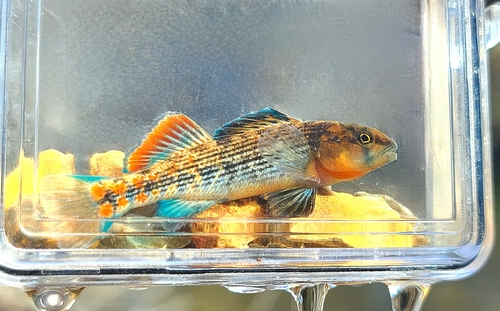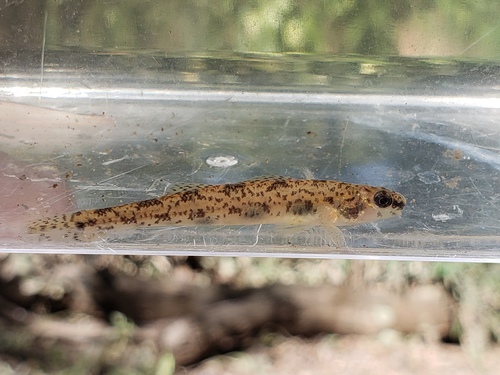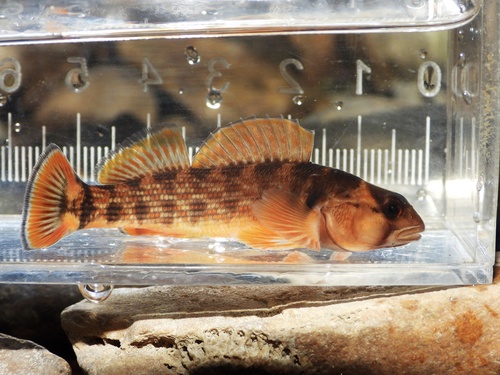
About Etheostoma bellum Zorach, 1968
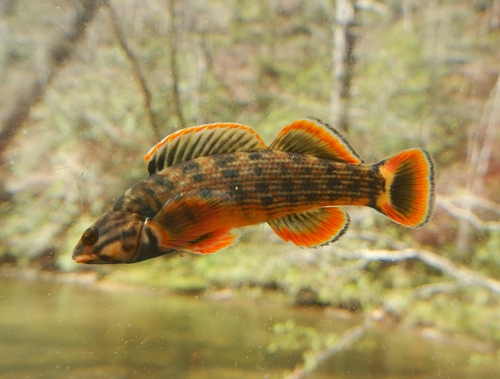
The orangefin darter (Etheostoma bellum) is a species of freshwater ray-finned fish. It is a darter from the subfamily Etheostomatinae, part of the family Percidae, which also contains perches, ruffes, and pikeperches. It is found in the Barren River and Green River systems of Tennessee and Kentucky. This moderate-sized fish usually reaches maturity between one and two years of age. Territorial males spawn over buried females in the gravel of fast-flowing riffle areas, and spawning typically occurs from late April to late June. Both juvenile and adult orangefin darters are active predators, and they feed mainly on dipteran larvae. Orangefin darters are only known to inhabit the Green and Barren River watersheds. The Green River is the larger of the two rivers, and the Barren River is a tributary of the Green River, which hosts a recognized biodiversity hotspot. This biodiversity hotspot is located in the 100-mile stretch of the Green River between the Green River reservoir dam and Mammoth Cave National Park. Over 150 fish species and 70 mussel species, plus many other aquatic species, have been recorded in this river system. The Green River drains into the Mississippi River, but orangefin darters do not range that far downstream. The Green River is a flowing system with many waterfalls, and mountain springs flow into it; its depth gives it a clear green appearance. The headwaters of the Barren River are mostly located in Tennessee, and the river then flows into Kentucky. The Barren River sits north of the Nashville Basin, in Clay, Macon, and Sumner Counties, draining the northward-sloping portion of the Highland Rim. It joins the Green River near Warren County, Kentucky. A typical Highland Rim stream has cool, clear water, gravel substrates, and riffle pool habitats. A 13-year study of the upper Green River system analyzed six endemic darter species, with over 300 sites sampled and landscape divided into five classes: agriculture, forest, water, and developed/exposed. Orangefin darters were detected at 46% of the sample sites, and occupy portions of all major river systems in the watershed. This darter occurred more frequently than the other five darter species included in the study. It was found most often near forest-covered areas or below large reservoirs. It also occurred around fine-loamy soils with good water velocity, and average water temperatures in the low 50 degrees Fahrenheit. This species requires specific habitat conditions to feed and spawn, and its habitats host predators and inter- and intraspecific competition. Larger freshwater fish such as catfish and smallmouth bass prey on orangefin darters. Intraspecific competition occurs because small invertebrates vary in abundance at different times of year, and accessing breeding areas is also a challenge. Darters also feed on small fish larvae, which increases competition within the species. Interspecific competition can result from high predator abundance or human-caused impacts to the environment. Increasing agricultural activity, deforestation, and pollution runoff into streams can reduce orangefin darter abundance. Dam construction slows water flow, which has a major impact on orangefin darters because they rely on rocky substrates and swift-moving riffles for hiding and feeding. The balance of their ecosystem must be maintained into the future, otherwise environmental stress on these endemic species could lead to extinction more quickly.