About Etheostoma asprigene (Forbes, 1878)
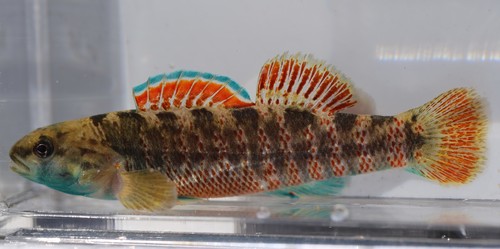
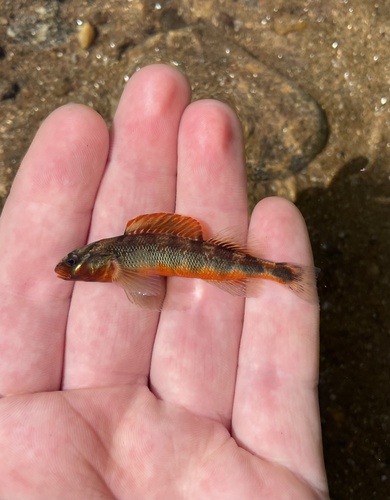
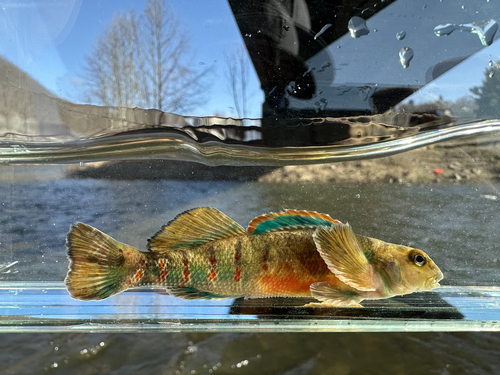
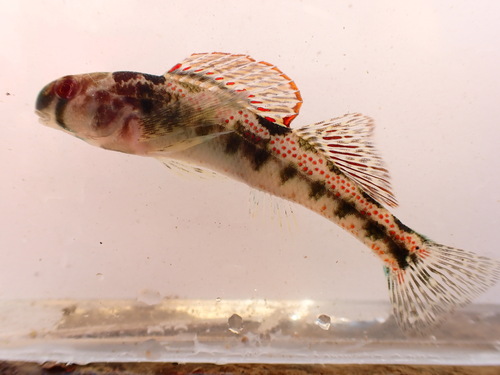
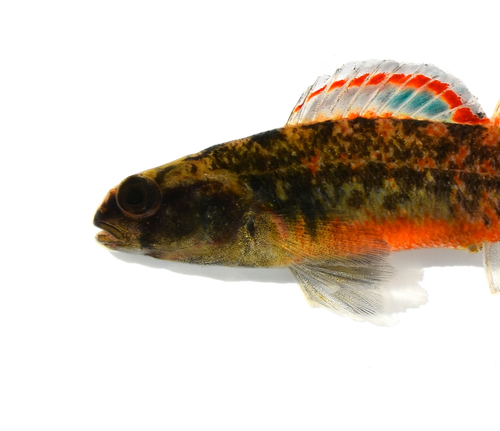
Etheostoma asprigene, commonly known as the mud darter, has a terminal mouth lined with small teeth on its jaws. Its back is olive or brown, marked with 8–11 dark blotches called saddles that cross the back. The sides of the mud darter feature 9–12 irregular dark brown vertical bars, and three vertically arranged spots sit at the base of its tail. The belly is most often cream or light olive. Mud darters can grow up to 7.1 cm (2.8 in) in total length, though most individuals only reach about 5 cm (2.0 in). Their caudal fin is typically rounded or square. The dorsal fin is split into two connected lobes: the first dorsal fin holds 10–12 spines, and the second holds 10–14 rays. Mud darters lack an adipose fin. Their anal fin usually has 2 spines and 8–9 rays. Mud darters are distributed across the lowlands of the Mississippi River Basin in North America, ranging from Wisconsin and Minnesota in the north down to Louisiana and eastern Texas in the south. They also occupy the Gulf Slope within the Sabine River and Neches River drainages of Louisiana and Texas. This species inhabits river mouths and overflow areas of large rivers, where it is most commonly found over mud substrates covered in sand or fine detritus. It can also be found on muddy bottoms in oxbow lakes, or in slow stream riffles. Large congregations of mud darters have been observed among finely divided tree roots along the shores of large rivers. Juvenile mud darters typically occupy quieter water areas than the slow riffles where adults are often found. Mud darters do not live longer than three years. After hatching, young fish grow rapidly, reaching half their first-year total length within just ten weeks. By the end of their first year, most individuals average between 3.3 and 4.4 cm (1.3 and 1.7 in) in length. By the end of their second and third years, most average between 4.3 and 5.5 cm (1.7 and 2.2 in). Survival from the first to second year is 75% for males and 81% for females, but survival drops drastically after the second year: only 14.5% of males and 12.1% of females survive from the second to third year. The mud darter spawning season runs from early March to early or mid-May, and females reach sexual maturity at one year of age. During the spawning season, males do not establish territories, but they become more aggressive toward other males. During courtship, the male swims around the female with his dorsal fin held erect, and sometimes rests his head on the female's nape. The female selects the spawning site, while the male follows behind her. The female enters vegetation vertically, and the male positions himself over the female, curving his body into an S-shape. The pair vibrates for a few seconds, and the female releases 5 to 10 eggs that fall onto the surrounding substrate or vegetation. The pair repeats this spawning process multiple times, resting between events from a few minutes up to half an hour.