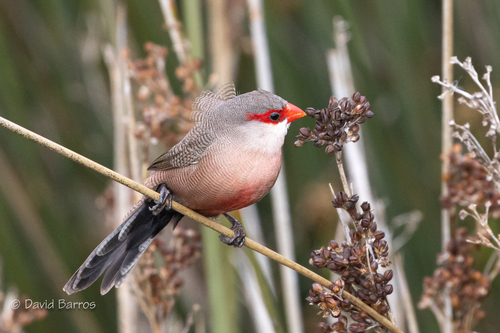
About Estrilda astrild (Linnaeus, 1758)
Estrilda astrild, the common waxbill, is a small bird that measures 4 to 5 inches in length, has a wingspan of 4 and a half inches, and weighs between 3/5 and 3/4 of an ounce. It has a slender body, short rounded wings, and a long graduated tail. Adult common waxbills have a bright red bill the color of sealing wax, which gives the species its common name. Their plumage is mostly grey-brown, finely barred with dark brown. They have a red stripe through the eye, and their cheeks and throat are whitish. Depending on the subspecies, they often have a pinkish flush on their underparts and a reddish stripe along the center of the belly. The rump is brown, while the tail and vent are dark. Females are similar in appearance to males, but are paler and have less red on the belly. Juveniles are duller overall, with little to no red on the belly, fainter dark barring, and a black bill. This species is similar to three other waxbill species: the black-rumped waxbill, crimson-rumped waxbill, and black-lored waxbill. The black-rumped waxbill has a black rump instead of a brown one, and a pale vent, the area underneath the tail. The crimson-rumped waxbill has a dark bill, red rump, and some red coloring on its wings and tail. The black-lored waxbill, which is only found in the Democratic Republic of Congo, has a black stripe through the eye instead of a red one. Common waxbills produce a variety of twittering and buzzing calls, along with a distinctive high-pitched flight call. Their simple song is harsh and nasal, and descends in pitch on the last note. There are approximately 17 subspecies of common waxbill, distributed widely across most of Africa south of the Sahara. They are present across most of East, Central, and Southern Africa, excluding desert regions or dense forest. In West Africa, their range is more localized, with the main population centered on Sierra Leone, Liberia, and the Ivory Coast. Common waxbills live in open country with long grass and rank vegetation. They are often found near water, in marshes and among reeds. They can be quite tame, and will enter gardens, parks, and farmland. Many common waxbills have escaped from captivity or been deliberately released, leading to established breeding populations in many warm locations with a sufficient supply of grass seeds. They are now found on many islands surrounding Africa, including Saint Helena, Ascension Island, the Cape Verde Islands, São Tomé and Príncipe, Mauritius, Réunion, Rodrigues, the Seychelles, and Ile Amsterdam; it is possible that some populations on these islands are native rather than introduced. In Europe, the common waxbill has become widespread in Portugal and is spreading through Spain. Small populations exist on Madeira and Gran Canaria, and the species has recently been recorded on Tenerife and in the Azores. In the Americas, common waxbills are found in Trinidad, several parts of Brazil, and a small number live on Bermuda. In the Pacific, populations are established on New Caledonia, Efate Island in Vanuatu, Tahiti, and the Hawaiian Islands. In Spain, the species was introduced to the largest cities within the last ten years, and is now quite commonly seen in Madrid, Barcelona, and Valencia, as well as along the Spanish-Portuguese border. The diet of the common waxbill consists mainly of grass and millet seeds, but insects are also eaten occasionally, especially during the breeding season when more protein is required. Guinea grasses (Panicum maximum) are one of the most important components of the waxbill diet, as their seed heads are available year-round. Other important seed sources include crabgrass (Digitaria horizontalis) and Echinochloa species. Common waxbills typically forage in flocks that may contain hundreds or even thousands of birds. They usually feed by clinging to grass stems with their long, spindly claws and picking seeds from the flower heads, but they will also search for fallen seeds on the ground. They need to drink regularly because the seeds they eat contain very little water.