About Esox niger Lesueur, 1818
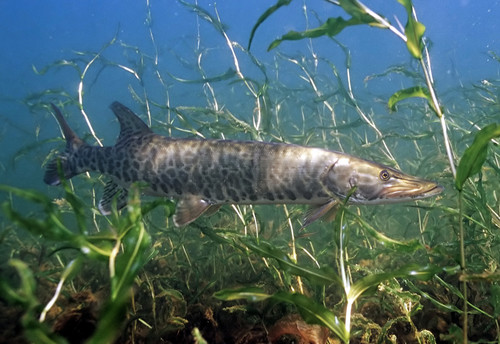
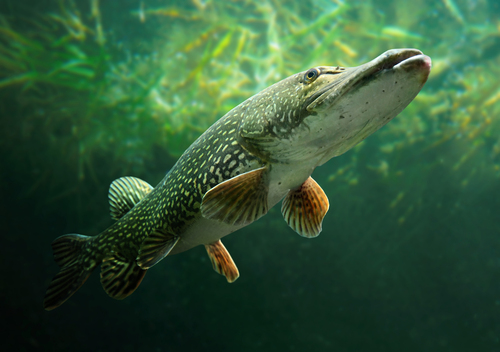
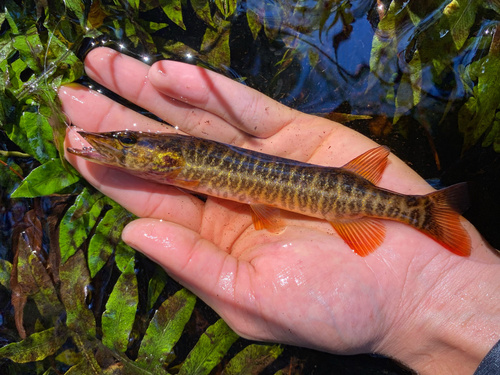
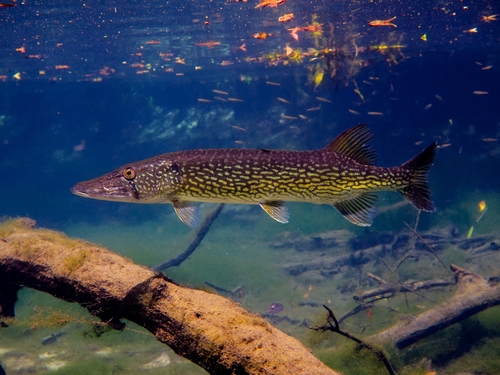
Chain pickerel (scientific name Esox niger Lesueur, 1818) has a distinctive dark chain-like pattern on its greenish sides. A vertical dark marking sits underneath its eye; this marking helps distinguish chain pickerel from redfin pickerel (Esox americanus americanus) and grass pickerel (E. americanus vermiculatus), which have a posteriorly curving marking instead. Its overall body shape is similar to that of the northern pike (E. lucius), but unlike northern pike, chain pickerel have fully scaled opercles and cheeks. Chain pickerel only very rarely reach a maximum length of 78.7 centimetres (31.0 inches). The average size of the species is 24 inches (61 cm) and 3 pounds (1 1/2 kg), and the average chain pickerel caught by fishermen weighs under 2 pounds. The typical lifespan of chain pickerel is around 8 years. In some regions, this species is nicknamed "gunfish", "gunny" or "slime dart" because of its characteristic slime coating. A blue color morph, which does not have the usual reticulated chain-like pattern, has been recorded in a population from New York. The natural range of chain pickerel extends along the eastern coast of North America, from southern Canada to Florida, and west as far as Texas. In New England, the species is found in Maine and New Hampshire. Chain pickerel inhabit fresh and brackish water in the Mississippi Valley, and they are also common in Lake Michigan and the lower Great Lakes. In the Canadian Maritimes, chain pickerel are found in New Brunswick and Nova Scotia. Chain pickerel is considered an invasive species in Nova Scotia; introduction of the voracious predatory fish has severely harmed native fish stocks. Illegal introduction of the fish has heavily impacted historical angling destinations on mainland Nova Scotia, such as Kejimkujik National Park. Chain pickerel occupy a wide variety of habitats, including pools in creeks or rivers, vegetated lakes, swamps and other wetlands. They can tolerate brackish water with salinity levels up to 22 ppt, and can survive in acidic water with a pH as low as 3.8. Spawning takes place in flooded vegetation at the end of winter or start of spring, when water temperatures range between 2–22 °C (36–72 °F). A secondary fall spawning event has been reported in Pennsylvania. Fertilization is external; adult fish mix eggs and sperm through movements of their tails. A female can release up to 50,000 eggs. No parental care is provided after spawning. Eggs hatch between six and twelve days after being laid. Newly hatched fry have adhesive glands on their snouts, which they use to attach to vegetation. The fry take six to eight days to fully absorb their yolk sac, after which they begin hunting actively.