About Esox masquinongy Mitchill, 1824
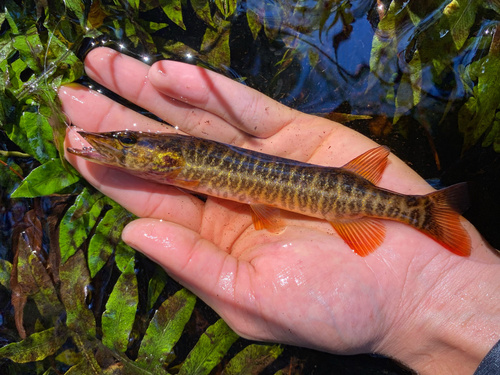
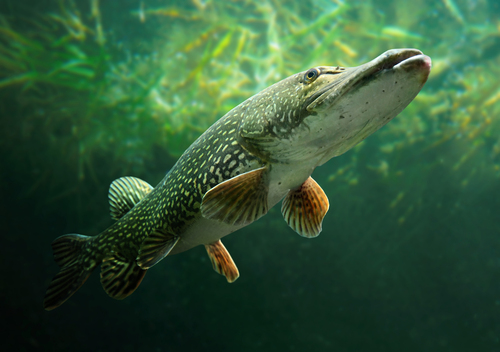
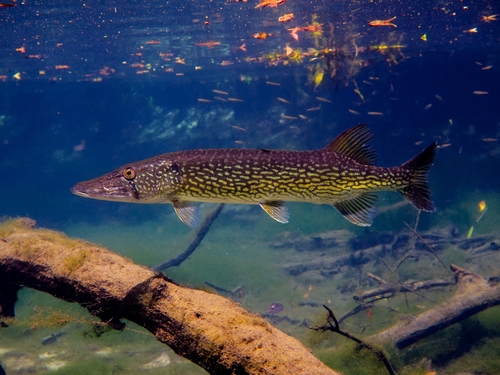
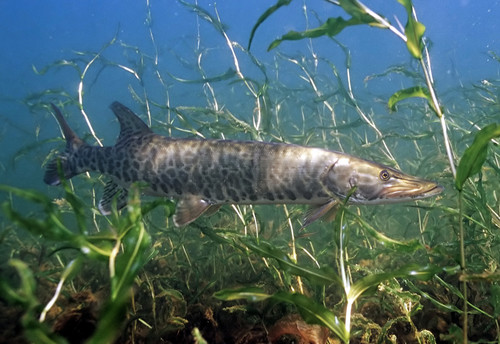
Muskellunge (Esox masquinongy Mitchill, 1824) closely resemble other esocids, including the northern pike (Esox lucius) and American pickerel (E. americanus), in both appearance and behavior. Like the northern pike and other aggressive pikes, their body shape follows the typical plan for ambush predators: they have an elongated body, a flat head, and dorsal, pelvic, and anal fins positioned far back along the body. Adult muskellunge are usually 70–120 cm (28–48 inches) long and weigh 7–16.5 kg (15–36 lb), though some individuals have grown as large as 1.8 m (6 ft) and almost 30 kg (70 lb). In November 2000, Martin Arthur Williamson caught a 27.8 kg (61.25 pound) muskellunge on Georgian Bay. Muskellunge bodies are typically light silver, brown, or green, with dark vertical stripes along their flanks. These stripes often break up into individual spots, and in some cases—especially in fish that live in turbid waters—markings may be absent entirely. This patterning differs from that of northern pike, which have dark bodies with light markings. A consistent way to tell these two similar species apart is by counting sensory pores on the underside of the lower jaw. Muskellunge have seven or more pores per side, while northern pike never have more than six. The lobes of the muskellunge's caudal (tail) fin end in a sharper point, compared to the generally more rounded tail lobes of the northern pike. Additionally, unlike pike, muskellunge have no scales on the lower half of their opercula. Anglers target large muskellunge as trophies or for sport. In areas where muskellunge are not native, such as Maine, anglers are encouraged not to release caught muskellunge back into the water, because the species negatively impacts native populations of trout and other smaller fish. Muskellunge inhabit oligotrophic and mesotrophic lakes and large rivers. Their native range stretches from Michigan, Wisconsin, and Minnesota through the Great Lakes region, Chautauqua Lake in western New York, north into Canada, throughout most of the St. Lawrence River drainage, and northward through the upper Mississippi valley. The species also extends as far south as Chattanooga in the Tennessee River valley. A small native population lives in the Broad River in South Carolina. Several reservoirs in North Georgia hold healthy stocked populations of muskellunge. They are also found in the Red River drainage of the Hudson Bay basin. Muskellunge were introduced to the western Saint John River in the late 1960s, and have since spread to many connecting waterways in northern Maine. Pineview Reservoir in Utah is one of three locations in the state where the hybrid Tiger muskellunge occurs. Muskellunge prefer clear waters, where they lurk along weed edges, rock outcrops, or other structures to rest. In summer, individual muskellunge establish two distinct home ranges: one shallow and one deep. The shallow range is generally much smaller than the deeper range, because shallow water warms to higher temperatures. Muskellunge continually patrol both ranges to search for food under appropriate water temperature conditions.