About Esox lucius Linnaeus, 1758
Scientific name: Esox lucius Linnaeus, 1758
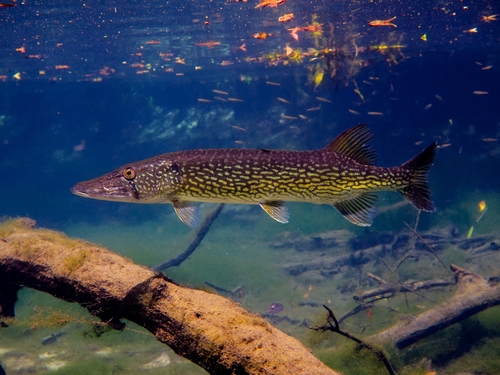
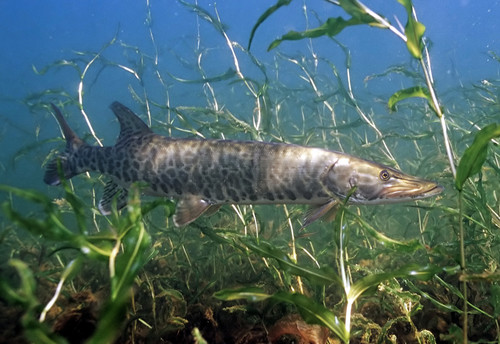
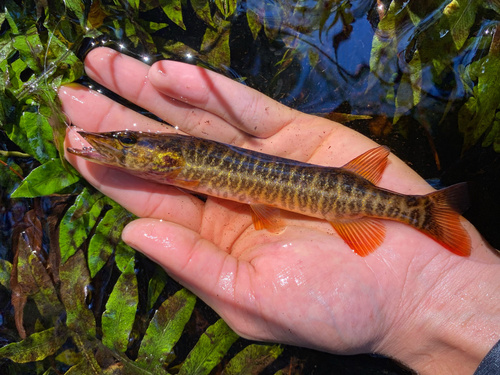
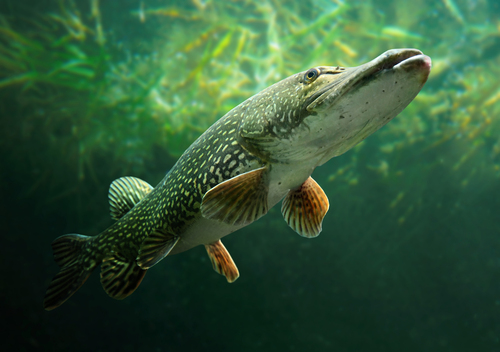
Description Northern pike are most often olive green, shading from yellow to white along the belly. Their flanks are marked with short, light bar-shaped spots, and their fins have anywhere from a few to many dark spots. Sometimes, the fins are reddish. Younger pike have yellow stripes along a green body; over time, these stripes split into light spots and the body color changes from green to olive green. The lower half of the gill cover has no scales, and the species has large sensory pores on its head and the underside of its lower jaw, which are part of the lateral line system. Unlike the similar-looking, closely related muskellunge, northern pike have light markings on a dark body background, and fewer than six sensory pores on the underside of each side of the lower jaw. A hybrid between northern pike and muskellunge is known as a tiger muskellunge, with the scientific name Esox masquinongy × lucius or Esox lucius × masquinongy, depending on the sex of each parent species. Among these hybrids, all males are sterile, while females are often fertile and may back-cross with the parent species. Another form of northern pike, the silver pike, is not a subspecies, but rather a mutation that occurs in scattered populations. Silver pike, sometimes called silver muskellunge, lack rows of spots and appear silver, white, or silvery-blue. When ill, silver pike can show a somewhat purplish hue; long illness is also the most common cause of male sterility in silver pike. In Italy, the newly identified species Esox cisalpinus ("southern pike") was long thought to be a color variation of the northern pike, but was announced as its own distinct species in 2011.
Habitat Pike are found in sluggish streams, shallow weedy areas of lakes and reservoirs, as well as in cold, clear, rocky waters. They are typical ambush predators: they lie in wait for prey, holding perfectly still for long periods, then strike with remarkable acceleration. They will live in any water body that contains fish, but suitable spawning sites are also essential. Because of their cannibalistic nature, young pike need shelter between aquatic plants to avoid being eaten. Both spawning sites and juvenile shelter require rich submerged vegetation. Pike are rarely found in brackish water except in the Baltic Sea area, where they can be found both at river mouths and in the open brackish waters of the Baltic Sea. It is normal for pike to return to fresh water after a period in these brackish waters. They appear to prefer less turbid water, which is likely related to their dependence on aquatic vegetation.
Geographic distribution Esox lucius is found in fresh water across the Northern Hemisphere, including Russia, Europe, and North America. It has also been introduced to lakes in Morocco, and is even found in the brackish water of the Baltic Sea, where it is confined to low-salinity surface water; it is very rarely seen in brackish water anywhere else. Within North America, northern pike populations are found in Maine, New Hampshire, Vermont, Massachusetts, Rhode Island, Connecticut, New York, New Jersey, Pennsylvania, Maryland, West Virginia, Ohio, Michigan, Indiana, Illinois, Wisconsin, Minnesota, Iowa, Missouri, North Dakota, South Dakota, Nebraska, Kansas, Montana, Idaho, Utah, Colorado, Oklahoma, northern Texas, northern New Mexico, northern Arizona, Alaska, the Yukon, the Northwest Territories, Alberta, Saskatchewan, Manitoba, Ontario, and Québec (pike are rare in British Columbia and east coast provinces). Watersheds that host pike include the Ohio Valley, the upper Mississippi River and its tributaries, and the Great Lakes Basin. They are also stocked in, or introduced to, some western lakes and reservoirs for sport fishing. Some fisheries managers believe this practice often threatens other fish species such as bass, trout, and salmon, leading government agencies to attempt to exterminate pike by poisoning lakes, for example Stormy Lake, Alaska. E. lucius is a severe invasive predator in Box Canyon Reservoir on the Pend Oreille River in northeastern Washington.
Reproduction Pike have strong homing behavior, and naturally inhabit specific areas. During the summer, they tend to group closer to vegetation than they do during the winter. The exact reason for this is not clear, but it is likely related to foraging, or possibly reproductive needs to protect young. Pike diel rhythm changes significantly over the course of the year. On sunny days, pike stay closer to the shallow shore. On windy days, they are further from shore. When close to shore, they prefer shallow, vegetated areas. Pike are more stationary in reservoirs than in lakes. One possible explanation is that lakes have more prey available, or that in reservoirs prey will eventually cross paths with the pike, so this stillness acts as a form of energy conservation. Pike breed in the spring. They become physically capable of breeding at around two years old, and spawn in spring when water temperature first reaches approximately 9 °C (48 °F). They tend to lay a large number of eggs. The likely explanation for this strategy is to produce as many surviving offspring as possible, since most die early in life. In females, the gonads enlarge when it is time to release eggs. After release, these eggs will not hatch if the water temperature is below 6 °C (43 °F). Male pike arrive at breeding grounds a few weeks before females, and remain after spawning is complete. Parental population size is important for successful pike reproduction. Egg survival has been shown to be positively correlated with the number of eggs laid. For breeding, more stable water leads to greater pike fitness. Egg mortality can be caused by toxic concentrations of iron or rapid temperature changes, and adult population abundance is not related to the strength of the resulting year class. Year class strength depends on two developmental periods: first, the embryo stage between fertilization and closure of the blastopore, and second, the period between hatching and the end of the alevin stage. The sticky eggs are yellow to orange in color, and have a diameter of 2.5 to 3 mm (0.098 to 0.118 in). After hatching, embryos are 7.5 to 10 mm (0.30 to 0.39 in) long and able to swim, but stay on the bottom for some time. The embryonic stage lasts five to 16 days, depending on water temperature (five days at 19 °C (66 °F), 16 days at 10 °C (50 °F)). Under natural conditions, survival from free-swimming larva to 75-mm pike is around 5%.
Food Young free-swimming pike feed on small invertebrates starting with Daphnia, and quickly move on to larger prey such as Asellus and Gammarus. When they reach 4 to 8 cm (1.6 to 3.1 in) in body length, they begin feeding on small fish. Northern pike have very typical hunting behavior: they can stay stationary in the water by moving the last fin rays of their dorsal fins and pectoral fins. Before striking, they bend their body and dart toward prey, using the large surface area of their caudal fin, dorsal fin, and anal fin to propel themselves. They have a distinctive habit of catching prey sideways in the mouth, immobilizing it with sharp, backward-pointing teeth, then turning the prey headfirst to swallow it. They eat mainly fish and frogs, but also prey on small mammals and birds. Young pike have been found dead from choking on a pike of similar size, an observation referenced by English poet Ted Hughes in his poem "Pike". Northern pike also feed on insects, crayfish, and leeches. They are not very selective in their diet: they eat spiny fish like perch, and will even take small fish such as sticklebacks when those are the only available prey. Pike are known to occasionally hunt and consume larger water birds; this includes a 2016 incident where an individual was observed trying to drown and eat a great crested grebe, an incident where a pike choked to death after killing and attempting to eat a tufted duck, and a 2015 incident where an attack by a large three to four foot long pike was considered a possible cause of the injury and death of an adult mute swan on Lower Lough Erne, Northern Ireland. However, it is generally accepted that such attacks are very rare. The northern pike is a largely solitary predator. It migrates during spawning season, and follows prey fish like common roaches to their deeper winter habitats. Sometimes, divers observe groups of similar-sized pike that cooperate to begin hunting at the same time, leading to "wolfpack" hunting theories. Large pike can be caught on dead immobile fish, so it is thought that these pike move over a rather large territory to find food. Large pike are also known to cruise through large water bodies a few meters deep, likely pursuing schools of prey fish. Smaller pike are more likely to be ambush predators, probably because they are vulnerable to cannibalism by larger pike. Pike are often found near culvert exits, which is explained by the presence of prey fish schools and good ambush opportunities. All esocids are potamodromous and tend to display limited migration, though some local movement can be key to population dynamics. In the Baltic, pike are known to follow herring schools, so they do have some seasonal migration.