About Esox americanus Gmelin, 1789
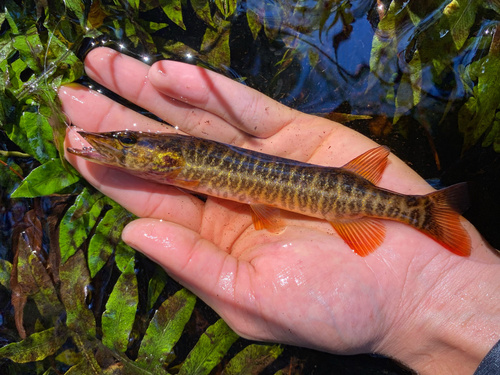
Esox americanus Gmelin, 1789 has two subspecies: redfin pickerel and grass pickerel. The two subspecies are very similar in appearance, but grass pickerel do not have the distinctive orange to red fin coloration that characterizes redfin pickerel. Grass pickerel fins have dark leading edges, and range in color from amber to dusky. Additionally, the light areas between the dark bands on the body are generally wider on grass pickerel, and narrower on redfin pickerel. The maximum recorded size for both grass and redfin pickerel is around 2 pounds (0.91 kg) in weight, and around 13 inches (33 cm) in length. Both redfin and grass pickerel are typically smaller than chain pickerel, which can grow much larger. Both redfin and grass pickerel occur primarily in sluggish, vegetated waters including pools, lakes, and wetlands. They are carnivorous predators that feed on smaller fish. When these pickerel venture into larger rivers or estuaries, they are in turn preyed on by larger fish species, including striped bass (Morone saxatilis), bowfin (Amia calva), and gray weakfish (Cynoscion regalis). To reproduce, the pickerel scatter spherical, sticky eggs in shallow, heavily vegetated waters. The eggs hatch after 11 to 15 days, and adult pickerel do not guard either the eggs or newly hatched young. Both subspecies are native to freshwater bodies of North America, and they are not to be confused with their larger, more aggressive close relative the northern pike. The range of redfin pickerel extends from the Saint Lawrence basin in Quebec down to the Gulf Coast, spanning from Mississippi to Florida. The range of grass pickerel is located further west, extending from the Great Lakes Basin (from Ontario to Michigan) down to the western Gulf Coast, from eastern Texas to Mississippi.