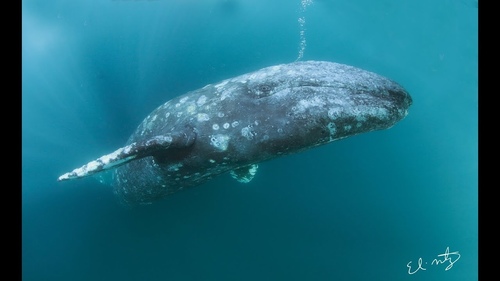
About Eschrichtius robustus (Lilljeborg, 1861)
The gray whale, scientifically named Eschrichtius robustus (Lilljeborg, 1861), has a base dark slate-gray body covered with characteristic gray-white patterns. These patterns are scars left by parasites that drop off when the whale is in its cold feeding grounds. Individual gray whales are typically identified by photographing their dorsal surface, then matching the unique scars and patches from parasites that have either fallen off or remain attached. Gray whales have two blowholes located on the top of their head, which can produce a distinctive heart-shaped blow at the water surface under calm wind conditions. Newborn gray whales measure 4.9 m (16 ft) in length, while adult gray whales reach 13–15 m (43–49 ft) in total length; adult females tend to be slightly larger than adult males. Newborns range in color from darker gray to black. A mature gray whale can weigh 40–45 tonnes (44–50 short tons), with a typical weight range of 15–33 t (17–36 short tons), making the gray whale the ninth largest cetacean species. Key features that set gray whales apart from other mysticetes include their baleen, which is colored cream, off-white, or blond, and is unusually short. Small depressions on the upper jaw each hold one single stiff hair, but these depressions and hairs are only visible upon close inspection. The ventral surface of the gray whale's head does not have the numerous prominent throat furrows found in related rorquals; instead, it has only two to five shallow furrows on the underside of the throat. The gray whale also lacks a dorsal fin, and instead has 6 to 12 raised dorsal crenulations, called "knuckles", along the midline of its rear quarter leading to the flukes. This row of bumps is known as the dorsal ridge. The gray whale's tail (fluke) is 3–3.5 m (10–11 ft) across, has a deep notch at its center, and tapers to pointed edges. Gray whale breeding behavior is complex and often involves three or more individual animals. Both male and female gray whales reach puberty between 6 and 12 years of age, with an average onset at 8 to 9 years. Females have highly synchronized reproduction, and enter oestrus in late November to early December. During the breeding season, it is common for a female to mate with several partners. This single annual ovulation event is thought to align with the species' annual migration patterns, which allow births to take place in warmer waters. Most females reproduce every two years, though annual births have been recorded. Males also experience seasonal changes: their testes mass increases during the period when females are in oestrus. There have been reports of males acting aggressively toward females that gave birth in the same year, with aggression sometimes causing injury or death to the female. There are no recorded live twin births, though one case of twin fetuses in utero has been reported. The gestation period for gray whales is approximately 13 and a half months, and females give birth every one to three years. In the second half of pregnancy, the fetus grows rapidly in both length and mass. Similar to the narrow breeding season, most calves are born within a six-week window in mid-January. Calves are born tail first, measure around 14–16 ft in length, and weigh approximately 2,000 lbs. Females lactate for around seven months after birth, after which calves are weaned and maternal care begins to decrease. The shallow lagoon waters where gray whales reproduce are believed to protect newborn calves from sharks and orcas. On 7 January 2014, a pair of dead conjoined twin gray whale calves (either newborn or aborted) were found in Laguna Ojo de Liebre (also called Scammon's Lagoon) off the west coast of Mexico. The calves were joined at their bellies.

