About Escallonia resinosa (Ruiz & Pav.) Pers.
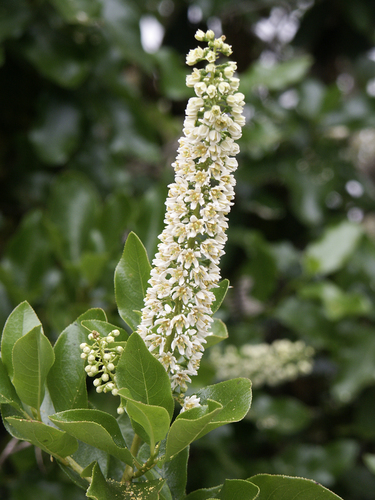
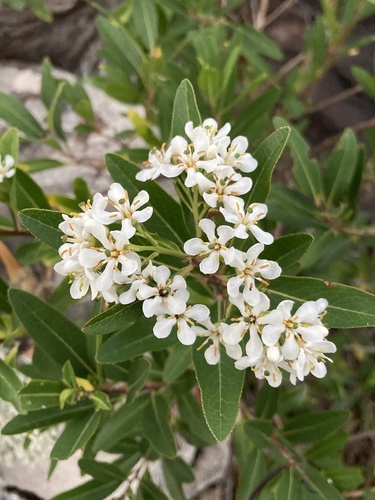
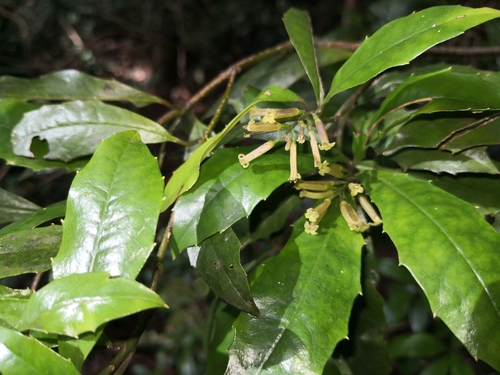
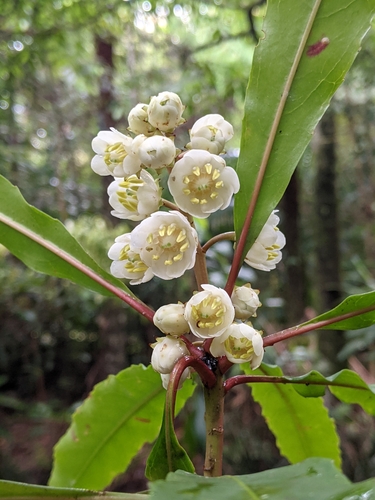
Escallonia resinosa (Ruiz & Pav.) Pers. grows as a shrub or tree reaching 2 to 10 meters in height. Its trunk is irregularly shaped, often twisted, and covered in reddish, papery bark. The leaves are simple, spirally arranged, and frequently clustered at the ends of branchlets; they are oblanceolate, 2–3.5 cm long and 0.5–0.7 cm wide, with finely toothed margins. Small white flowers, roughly 1 cm long, grow in racemes or panicles.
This species is native to the Andes, ranging from southern Ecuador through Peru to Bolivia, where it occurs at elevations between 2600 and 4200 meters. It grows in seasonally dry montane forests on mountain slopes, and is often found growing alongside trees from the genera Polylepis and Buddleja.
Throughout its native range, Escallonia resinosa provides good quality wood and is a common source of firewood. Its hard wood is used for making tools, and Andean indigenous peoples have used it since ancient times to manufacture chaquitacllas, a traditional plowing tool. The wood was also likely used by the Incas to make a type of ceremonial vase called a kero. Its leaves are used to produce a beige dye for cotton and wool.