About Eryx jayakari Boulenger, 1888
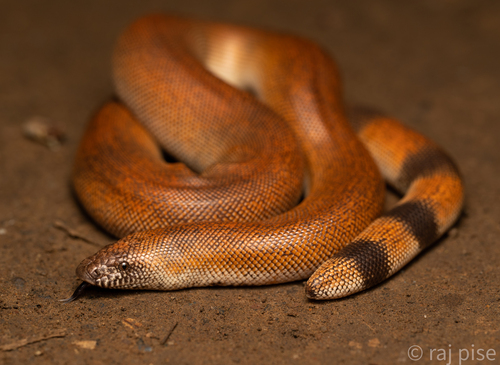
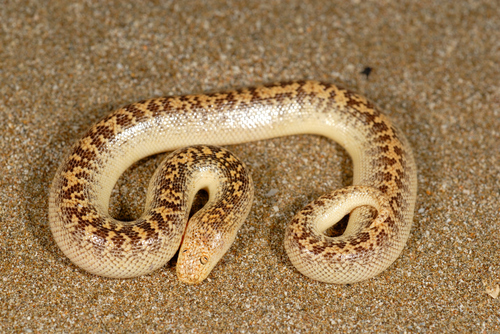
The Arabian sand boa (Eryx jayakari Boulenger, 1888) is a small snake that reaches a total length including tail of approximately 38 centimeters (15 inches). It has a wedge-shaped head with a blunt snout, and very small eyes positioned on the top of the head. Its base coloration is yellowish-grey or sandy-brown, marked with white speckled flecks and dark transverse bands. This species is native to the Arabian Peninsula, with a known geographic range that covers Saudi Arabia, Oman, Yemen, and Kuwait. It also occurs in southern Iran, where a small number of specimens have been recorded in Khuzestan Province, Bushehr Province, and Kerman Province. The Arabian sand boa is a desert-dwelling snake that lives semi-subterranean in sand or soft soil. Unlike most other members of the Boidae family, the Arabian sand boa lays eggs rather than giving birth to live young; the only other known egg-laying Boidae species is the Muller's sand boa. The female produces a small clutch of eggs, which hatch after approximately 66 days when incubated at 33 °C (91 °F). Hatchlings of this species do not develop an egg tooth to help them break out of their shells when they are ready to hatch; instead, the mother assists her offspring in opening their eggshells.