About Eryx conicus (Schneider, 1801)
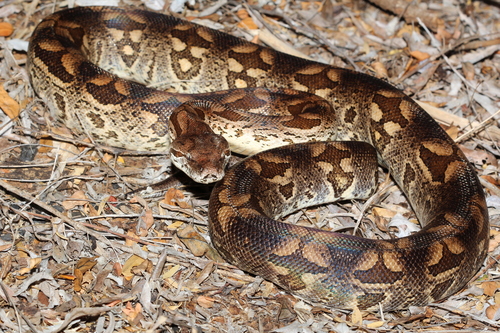
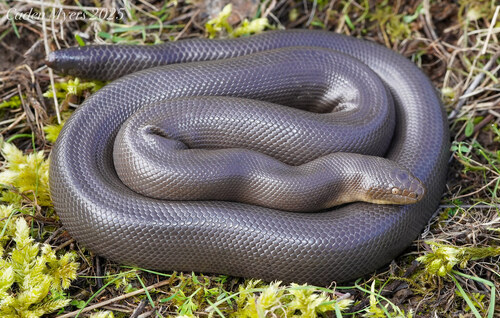
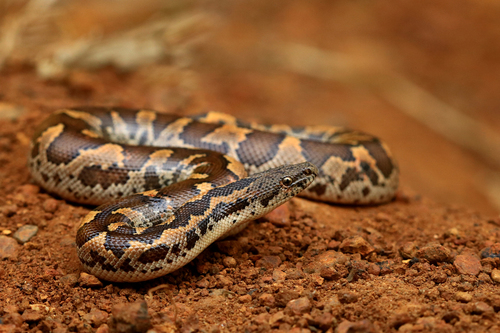
Scientific name: Eryx conicus (Schneider, 1801). Description: Adult Eryx conicus can reach a total length of 3 feet 3 inches (99 cm), which includes a 3-inch (76 mm) tail. The anterior teeth on the maxilla and mandible are longer than the posterior teeth. The head is covered in small scales, the eye is small with a vertical pupil, dorsal scales are small and keeled, and the tail is pointed, with no or only very slight prehensile ability. The rostral scale is twice as broad as it is long, slightly prominent, and lacks an angular horizontal edge. The top of the head is covered in small, obtusely keeled scales, with the exception of the enlarged nasals and internasals. There are 8 to 10 interorbital scales, and 10 to 15 circumorbital scales. One or two rows of scales separate the eye from the labials. There are 12 to 14 supralabial scales. Dorsal scales have tuberculate keels, and are arranged in 40 to 49 rows. There are 162 to 186 ventral scales, the anal scale is single, and there are 17 to 24 subcaudal scales. The anterior dorsal scales are only feebly keeled, but keel size increases toward the posterior end of the body, becoming heavily keeled enough that handling a squirming specimen can be quite painful. This heavy keeling also makes the anterior and posterior portions of the body appear to belong to distinctly different animals. Dorsally, the color pattern is made up of a broad zigzag band or a series of dark brown blotches, set against a yellowish or brownish grey ground color. The belly is uniform solid white. In India, this species can easily be mistaken at first glance for either the Indian python (Python molurus) or the venomous deadly Russell's viper (Daboia russelii). Geographic range: Eryx conicus is found in India south of approximately 30°N latitude, Nepal, Bangladesh, and the northern arid region of Sri Lanka. Its given type locality is "India orientali". Habitat: The preferred habitat of Eryx conicus is sandy tracts in central and southern India, the Punjab, Kachchh, and Sind. Reproduction: Eryx conicus is viviparous.