About Erythrura pealii Hartlaub, 1852
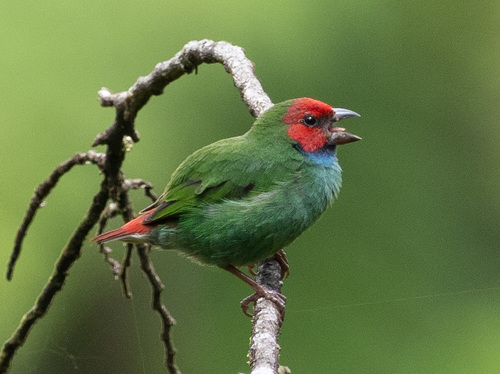
The Fiji parrotfinch (Erythrura pealii Hartlaub, 1852) is a small finch that measures 10 cm (4 in) in length. Adult males have a bright green body and wings, a red head, and a scarlet rump and tail. The blackish feathering on the chin transitions to dark blue on the lower throat and turquoise on the upper breast, before fading into the green of the underparts. This species has a stubby blackish-grey bill, reddish-brown eyes, and pinkish-brown legs and feet. Females are very similar to males, but are possibly slightly duller in color and have paler flanks. Juveniles have a dark-tipped yellow bill and sometimes a bluish face that gradually turns red; the rest of their plumage matches that of adult birds. Young Fiji parrotfinches gain full mature plumage at approximately 20 months of age. A small number of rare individuals have an entirely blue head and face, which appears to be caused by a natural mutation. The flight of the Fiji parrotfinch is fast and undulating, with rapid wingbeats and frequent calling. It typically flies fairly high, lands in tree tops, then descends to search for food. Its call is a high, thin seep or peep, similar to the calls of other parrotfinches such as the blue-faced parrotfinch and red-throated parrotfinch, and is often repeated in bursts of varying length. Its song is a long whistled double note, similar to that of the orange-breasted myzomela, a Fijian endemic honeyeater, but less urgent. Fiji is home to another Erythrura species, the rare and endangered pink-billed parrotfinch. The pink-billed parrotfinch is larger, with a green head, blue crown, black face, and a very large pink bill. The Fiji parrotfinch resembles the closely related royal parrotfinch and red-headed parrotfinch, and the rare blue-headed Fiji parrotfinch variant is very similar to the blue-faced parrotfinch, but none of these three species occur in Fiji. The Fiji parrotfinch is endemic to Fiji, where it occurs on the country’s four largest islands (Viti Levu, Vanua Levu, Taveuni and Kadavu), as well as the smaller western islands of the Mamanuca and Yasawa groups. It is uncommon but widespread, found in both forested and open habitats, ranging from sea level to at least 1,200 m (3,900 ft) on Viti Levu. It appears to be less common on Taveuni than it is on Fiji’s larger islands. It has adapted well to human-made habitats, and can be seen in grasslands, pastures, rice paddies, parks and gardens. Most parrotfinch species are primarily forest birds, but American ornithologist Jared Diamond has suggested that in the central Pacific, where no seed-eating munias occupy open habitats, species such as Vanuatu's blue-faced parrotfinch and the Fiji parrotfinch have expanded into grassy areas of their islands to use available seed supplies.