About Erythroxylum coca Lam.
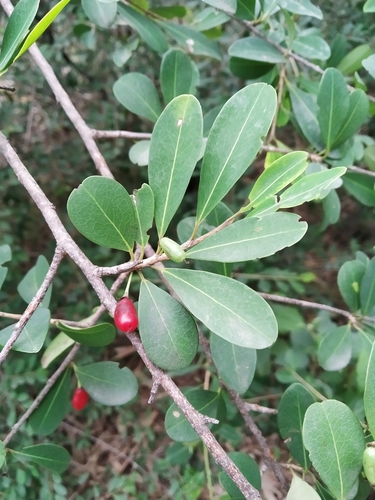
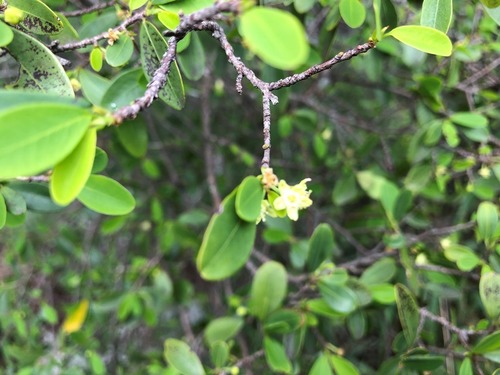
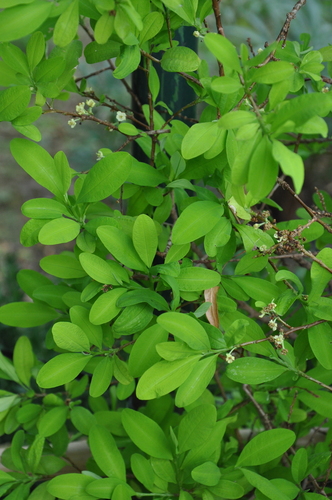
Erythroxylum coca Lam., commonly known as coca, resembles a blackthorn bush and grows to a height of 2–3 m (7–10 ft). It has straight branches, and its thin, opaque, green-tinted leaves are oval and taper at both ends. A distinct feature of the leaf is an areolated section bounded by two longitudinal curved lines, one on each side of the midrib, that is more visible on the underside of the leaf. This species is mainly found in Colombia. Its small flowers grow in small clusters on short stalks; the corolla is made up of five yellowish-white petals, the anthers are heart-shaped, and the pistil is formed from three united carpels that create a three-chambered ovary. After flowering, the plants produce mature red berries. Unlike the related cultivated species Erythroxylum novogranatense, Erythroxylum coca requires very acidic growing conditions: both soil and water acidity must be below pH 5.5, with an optimal pH of 3.5, which is similar to the acidity of Rhododendron potting soil. At a pH of 6.5 or higher, Erythroxylum coca develops chlorosis and leaf distortion. Among the two widely cultivated coca species, Erythroxylum coca has higher resistance to the herbicide glyphosate than Erythroxylum novogranatense. In its ecology, the leaves of Erythroxylum coca are sometimes eaten by the larvae of the moth Eloria noyesi.