About Erythrostemon gilliesii (Hook.) Klotzsch
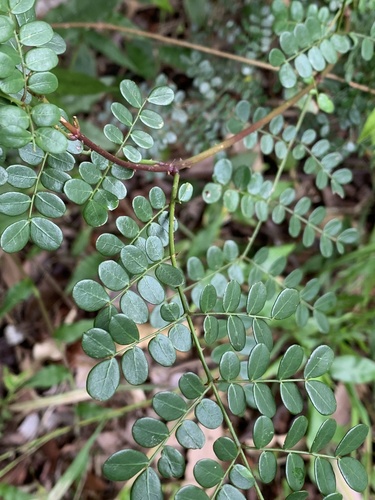
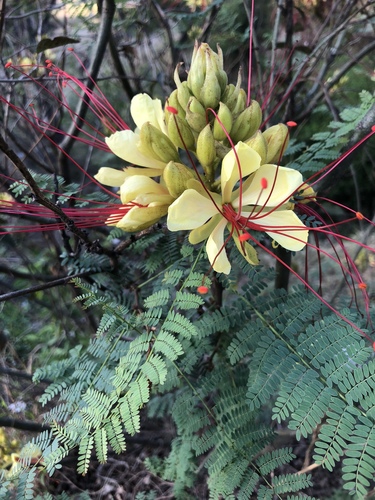
Erythrostemon gilliesii (Hook.) Klotzsch is a large, upright evergreen shrub with an open, rounded growth habit. It grows up to 5m (16.5 ft) tall, with final height dependent on rainfall. Its leaves are 2-pinnate (also called bipinnate), 10–15 cm (4–6 in) long, and bear 3–10 pairs of pinnae. Each pinna holds 6–10 pairs of leaflets that measure 5–6 mm (0.20–0.24 in) long and 2–4 mm (0.079–0.157 in) wide. This species produces yellow flowers arranged in racemes up to 20 cm (8 in) long. Each individual flower has five yellow petals and 10 long, prominent crimson (red) stamens that are a distinct feature of the plant. Its seed pods are densely covered in short, red glandular hairs. The seeds and green seed pods of this plant are toxic. Ingestion of these plant parts can cause poisoning, which leads to severe vomiting and other abdominal symptoms. Erythrostemon gilliesii is a striking ornamental plant native to South America, where it occurs mainly in Argentina and Uruguay. It has become naturalized in Texas, and is fairly common across the rest of the southwestern United States. In this region, it is known by the common names bird of paradise bush, desert bird of paradise, yellow bird of paradise, and barba de chivo. Though it is a tropical species adapted to dry climates, it also grows well in the climate of Avsa and neighboring islands off the southern coast of the Sea of Marmara in northwestern Turkey. In this area, it is commonly called Paşabıyığı (Pasabiyigi), Cennetkuşu ağacı (Cennetkusu agaci) — which translates to "bird of paradise tree" in Turkish — and Bodurakasya, which means "dwarf acacia". This species is also fairly common in the Karoo region of South Africa, and can be found in the Catalonian and Valencian regions of Spain. Medicine men of indigenous peoples of the Amazon rainforest used Erythrostemon gilliesii, along with the similar species Caesalpinia pulcherrima which they called ayoowiri, to treat fever, sores, and cough. Four grams of root from this plant is reported to induce abortion during the first trimester of pregnancy. Research has found that this plant has antimicrobial effects, and it may also be used to extract contaminants from soil.