About Erythropygia quadrivirgata (Reichenow, 1879)
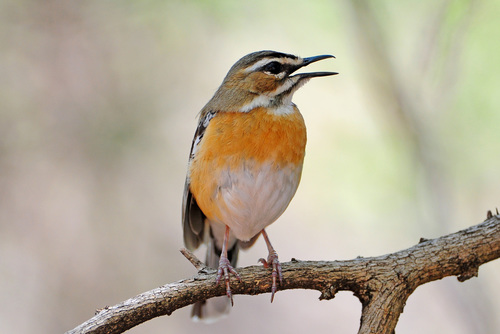
Erythropygia quadrivirgata measures 15–17 cm (5.9–6.7 in) in length, and weighs approximately 20–31 g (0.71–1.09 oz). Males and females have similar plumage, though females are slightly smaller. For adult individuals, the crown and upperparts are mostly dark olive-brown. The tail is dark brown, and the outer tail feathers have white tips. Wing coverts are grey-brown with olive-brown edges. Flight feathers are dark brown, and have a white patch. On the face, this species has a white supercilium, a white crescent shape below the eye, a white moustachial line, a black malar stripe, and additional black lines running above the supercilia. Eyes are dark brown, and lores are black. The throat and upper breast are white. Breast sides and neck sides are rufous-brown to rufous. The belly and undertail coverts are white. The beak is black, and legs are pinkish-brown. Juveniles are paler brown overall, with black patterns on the crown and back; their underparts are buff with dark patterns. The subspecies C. q. greenwayi has greyer upperparts, a duller rump, and a paler breast than the nominotypical subspecies. This species is distributed across Botswana, Eswatini, Kenya, Malawi, Mozambique, Namibia, Somalia, South Africa, Tanzania, Zambia, and Zimbabwe, with an estimated total distribution area of 5,390,000 km2 (2,080,000 sq mi). It is mostly found at elevations below roughly 1,000 m (3,300 ft). It inhabits sand forests, riverine woodland, scrubs, and evergreen forests, and sometimes occurs in gardens and reedbeds, but it usually does not live in damp areas. In the 1950s, deforestation near Hluhluwe and False Bay destroyed part of this species' habitat, but its range may have expanded in other areas. After tsetse fly deterrent was sprayed in Hluhluwe-Umfolozi Game Reserve in the 1940s, bearded scrub robins disappeared from the area, but they recolonized it by 1975. The species has also expanded its range into Matobo National Park and Richards Bay.