About Erythronium revolutum Sm.
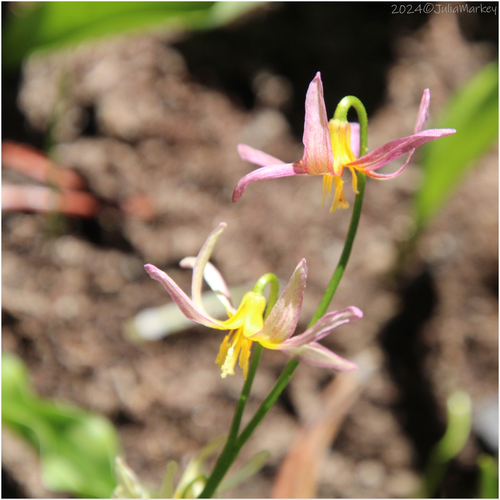
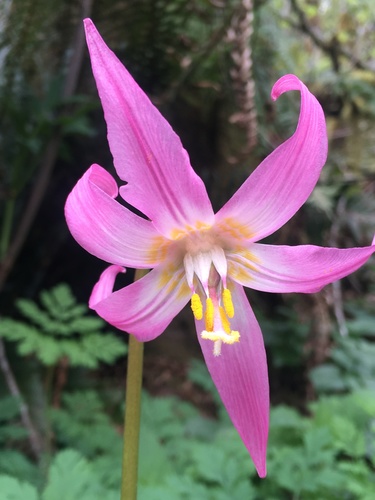
Erythronium revolutum Sm. is a hardy perennial wildflower that grows from an oval bulb 3 to 5 centimeters (1 to 2 inches) long. It usually produces two wide, flat, mottled green leaves near the ground. It is indigenous to Northwest Washington, and flowers between March and June. Each bulb sends up a long, naked stalk that bears one or two showy lily flowers. The stalk bends at its end so the flower face points toward the ground. The flower has six tepals in shades of pink or light purple, which may have yellow or white spotting toward the flower's center. Tepals can be straight or so strongly recurved that their tips meet behind the flower; they tend to recurve further as the flower ages. The anthers are bright yellow. This species can be distinguished from related species by its pink flowers, swollen anther filaments, and mottled leaves. Its fruit is a capsule that grows up to 6 centimeters (2 inches) long. Erythronium revolutum is native to western North America, ranging from coastal Northern California to British Columbia, including Vancouver Island. It grows in wet areas within forests and along stream banks. It is most abundant within 100 miles (161 km) of the coast, at altitudes below 1000 m. It can be found in moist locations including streambanks, bogs, and the understory of wet redwood and mixed evergreen forests. This plant is slow-growing, taking 5 to 7 years to develop a bulb large enough to flower, so it establishes slowly in new locations. Its native habitats are threatened in the wild, and the species also faces additional threats from collection for horticultural use and soil compaction caused by forestry machinery. Erythronium revolutum is cultivated as an ornamental plant for use in traditional and natural gardens. Its combination of attractively patterned leaves and graceful mid-spring flowers makes it a desirable garden plant. Selected cultivated forms, often called var. johnstonii, have darker, richer pink flowers and clearly marked foliage. For best growth, it should be planted in a shady spot, ideally beneath deciduous trees or shrubs, in humus-rich soil that does not dry out and stays rather damp in spring. Over time it can naturalize by self-seeding, though this process is slow because seedlings require several years to reach flowering size.