About Erythronium americanum Ker Gawl.
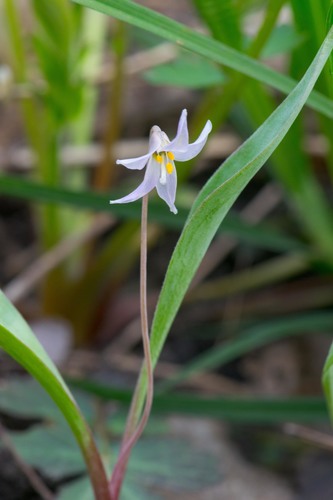
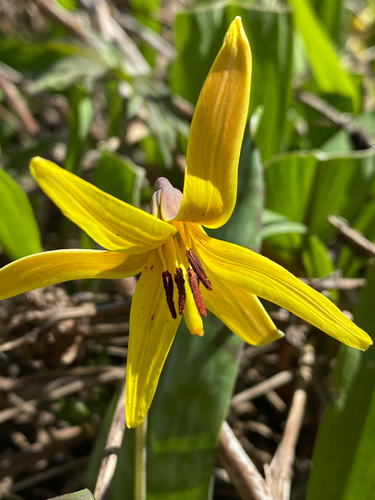
Erythronium americanum Ker Gawl. has multiple common names: trout lily, yellow trout lily, fawn lily, yellow adder's-tongue, and yellow dogtooth violet. It is a perennial, colony-forming, spring ephemeral flowering plant native to North America, where it grows in woodland habitats. Across its native range, it is a very common and widespread species, particularly in eastern North America. The common name "trout lily" comes from the appearance of its gray-green leaves, which are mottled with brown or gray markings that are said to resemble the coloring of brook trout. Its geographic range extends from Labrador in the north south to Georgia, west to Mississippi, and north again to Minnesota.
Sexual reproduction in Erythronium americanum is not very effective: only 10% of pollinated flowers go on to develop seeds. The fruit produced is a capsule 12 to 15 millimeters long, held above the ground by the flower stalk. This species is myrmecochorous, meaning ants help disperse its seeds and reduce seed predation. Its seeds have a structure called an elaiosome that attracts ants, making the seeds more appealing to the insects.
Erythronium americanum grows from an oval underground corm that measures 15 to 28 millimeters across. The corm is most often found in the upper 11 centimeters of soil, but it can grow as deep as 30 centimeters. Compared to other plants in the lily family, the corms of E. americanum are buried very deeply. Corms are mostly made up of storage tissue that holds large amounts of energy-rich starch. Each corm is covered by a papery husk, which is the leftover remains of the previous year's flower stalk. Trout lilies grow in colonies, and some of these colonies have been dated to be up to 300 years old. Individual plants within a colony often reproduce asexually via a structure called a dropper, or from small buds that grow into new bulbs off the main corm. A dropper is a fleshy tubular stem that grows out from the parent corm, first extending up toward the soil surface, then penetrating back deep into the soil, where a new corm forms at the dropper's tip. After the new corm forms, the stem connecting the daughter corm to the parent corm dies.