About Erythronium albidum Nutt.
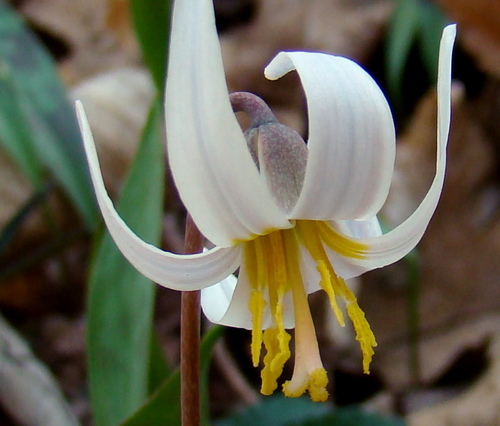
Erythronium albidum Nutt., commonly known as white fawnlily, often forms large extensive colonies. Within these colonies, immature, non-flowering plants that produce only one leaf far outnumber flowering plants, which have two leaves. Flowering two-leaved plants grow a short, slender, red stem that reaches 10–15 cm (4–6 in) tall, and this stem bears two oblong basal leaves. The leaves are lanceolate, measuring 8–16 cm (3+1⁄4–6+1⁄4 in) long and 3–4 cm (1+1⁄4–1+1⁄2 in) broad. They are dark green and patterned with mottled purple blotches. It is difficult to distinguish Erythronium albidum from Erythronium americanum based on leaves alone. The root system of this species consists of a central corm that produces stolons, which allow the plant to spread slowly and form large colonies. The corms of this lily are said to resemble dog teeth. The plant’s foliage dies back completely during the summer. At the end of the stem, the plant produces a white, lily-like flower 3–4 cm (1+1⁄4–1+1⁄2 in) in diameter. This flower has six white tepals (3 true petals and 3 petal-like sepals) and six yellow stamens. The backs of the tepals are often violet-colored near their point of attachment to the stem. The flowers face downward, and they elongate as they age. Flowers close at night and do not reopen until the following morning, and they bloom from mid to late spring. The fruiting body is an ovular three-chambered capsule that can grow up to 2.5 cm (1 in) in length. White fawnlily is native to eastern North America. Its range extends from southern Quebec and southern Manitoba in the north, south to Georgia and Texas. The plant usually grows in large groups on the forest floor, often in areas that have experienced recent ground disturbance. It prefers growing conditions ranging from part sun to mostly shade, and deep, moist loamy soils. In cultivation, Erythronium albidum grows well in humusy, moist, acidic soils with full to partial shade, and can be grown in USDA hardiness zones 3 to 8. Corms are often available for purchase from garden centers and nurseries. This plant can also be grown from seed, but seed-grown plants will not produce flowers for 4 to 5 years. Corms should be planted in the fall, 2 to 3 inches deep and 4 to 5 inches apart. Fawnlilies do not transplant well, so wild populations should be left undisturbed. European settlers believed white fawnlily had similar medicinal properties to meadow saffron (Colchicum autumnale), and often used it as a substitute for meadow saffron. This plant was listed in the Pharmacopoeia of the United States from 1820 to 1863 as a treatment for gout. Some folk beliefs hold that wounds can be healed by soaking the plant in cold water, then removing it, wrapping it in cloth, applying it to a wound or bruise, leaving it in place until the bundle becomes warm, and then removing it and burying it in a muddy place. Very little is known about the plant’s chemical constituents, as little research has been conducted on it. It is known to contain α-methylene butyrolactone. When fresh, the plant acts as an emetic, emollient, and antiscorbutic; when dry, it is considered nutritive. Certain Native American groups used it for its emetic properties and as a contraceptive. Onondaga women used the leaves of white fawnlily as a temporary birth control method in the spring, to avoid giving birth during the coldest part of winter. Leaves can be collected at any time of year, but the corm (bulb) enlarges through the summer and can be divided in the fall. Fall-harvested bulbs are also edible. Fresh leaves are most commonly used to make a stimulating poultice, which is applied to swellings, tumors, and scrofulous ulcers. When brewed into a tea with horsetail (Equisetum hyemale), it is claimed to be helpful for bleeding or ulcers of the bowels, as well as for tumors and inflammation of the bowels. It has also been used to provide quick relief for nose bleeds and sore eyes. Fresh roots or leaves can be simmered in milk, or the plant’s juice can be infused in apple cider; these preparations are used to treat dropsy, hiccups, vomiting, and bleeding of the bowels. Misuse of this plant may cause nausea or even vomiting.