About Erythrina velutina Willd.
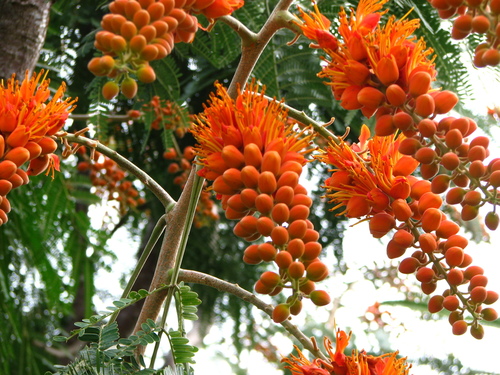
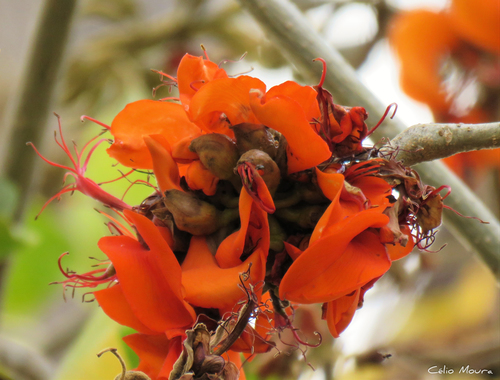
Erythrina velutina Willd. is a species of leguminous perennial tree. It is native to Brazil, Peru, Ecuador, Colombia, Venezuela, and Hispaniola, and has been introduced to most of the Caribbean, Uganda, and Sri Lanka. It also grows on the Galápagos Islands, but it is unclear whether the species is indigenous or introduced there. In Brazil, it grows on plains and near rivers in the arid regions of the country's northeast, where it is commonly called "mulungu". Erythrina velutina grows as a large tree reaching around 10 m (30 ft) in height, and has short spines on its stem. The seeds of Erythrina velutina are bean-like, red, and toxic. They should not be ingested, as consumption carries a risk of death. In northeastern Brazil, the bark of E. velutina is used in traditional medicine to treat insomnia, convulsions, nervous coughs, and nervous excitation. Harvesting bark for medicinal use threatens the survival of the species, so many scientific studies of the tree's medicinal effects have used leaf extract instead. In laboratory tests on mice and rats, E. velutina extract prolongs sleep, inhibits motor activity, and inhibits memory. Erythrina velutina contains the indole-based alkaloid hypaphorine, which has been found to produce sleep-promoting effects in mice.