About Erythranthe lewisii (Pursh) G.L.Nesom & N.S.Fraga
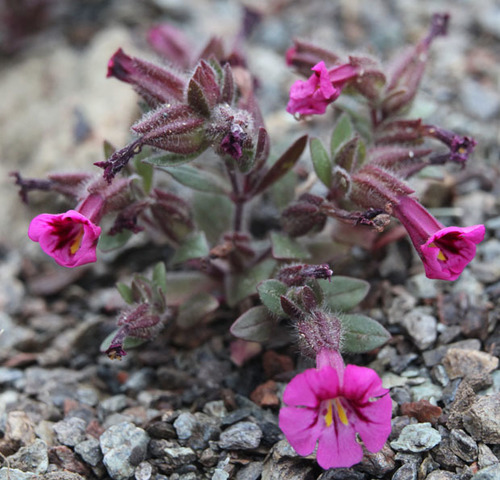
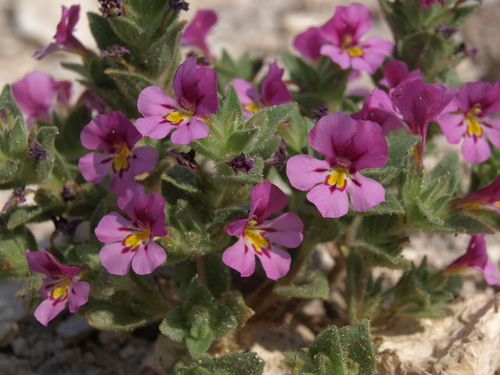
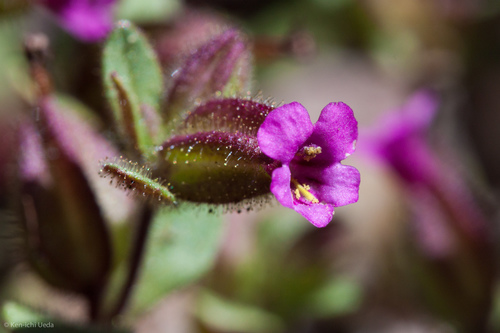
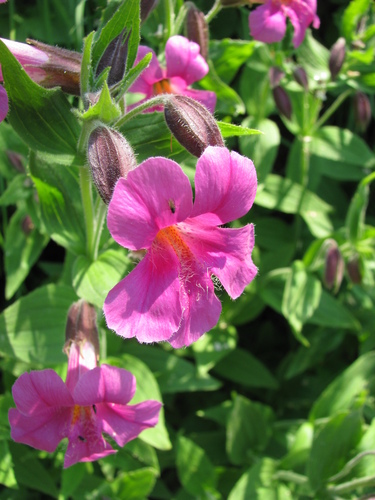
Erythranthe lewisii is a perennial herb. Its stems grow between 25 and 80 cm long, and individual leaves measure 20 to 70 mm. All vegetative tissue of the plant is covered in fine hairs. Its medium-sized flowers grow on fairly long pedicels that range from 30 to 70 mm in length. Flower color varies from pale pink to dark magenta: pale pink flowers are most common in populations native to the Sierra Nevada, and these pale pink populations are sometimes classified as a separate species, Erythranthe erubescens G.L.Nesom. Dark magenta flowers are more common in populations from the Cascade Range and Rocky Mountains. The lower corolla lobe has a central pair of carotenoid-rich yellow nectar guides covered in trichomes. Occasional populations have individual white-flowered plants, which do not produce anthocyanin pigments in their corollas. This species is native to western North America, ranging from Alaska through California to Colorado. It grows in moist habitats such as stream banks, and is generally found at higher elevations in montane regions. Erythranthe lewisii is pollinated by bees, primarily species from the Bombus and Osmia genera; these bees feed on the plant's nectar and transfer its pollen. While E. lewisii is fully interfertile with its sister species E. cardinalis, the two do not interbreed in the wild. This reproductive isolation is primarily attributed to different pollinators: E. cardinalis is pollinated by hummingbirds in overlapping ranges. This plant is cultivated as an ornamental for mild or cool coastal climates, because it cannot tolerate prolonged freezing temperatures. In the United Kingdom, it has received the Royal Horticultural Society's Award of Garden Merit. It grows best in very damp soil positioned in full sunlight. Native Americans ate the leaves of this plant.