About Erythranthe guttata (DC.) G.L.Nesom
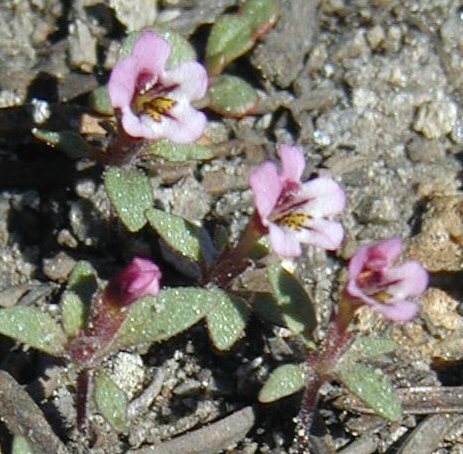
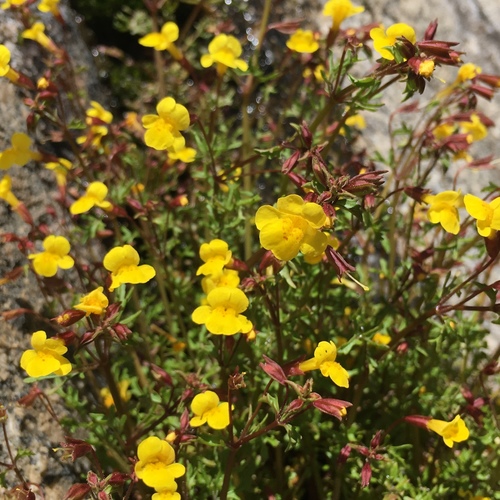
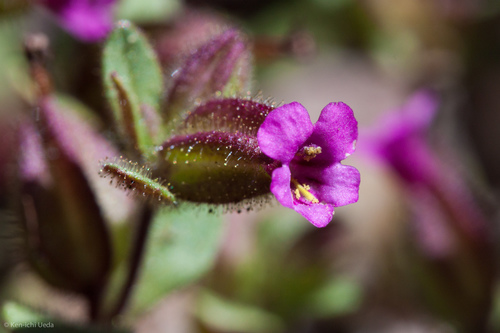
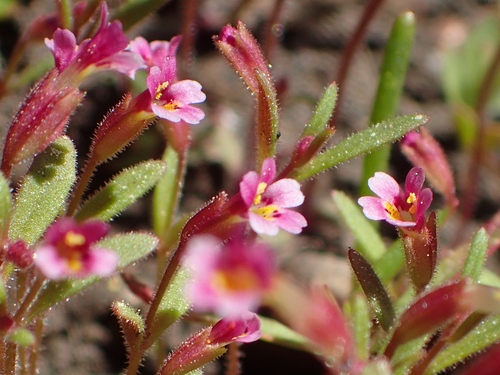
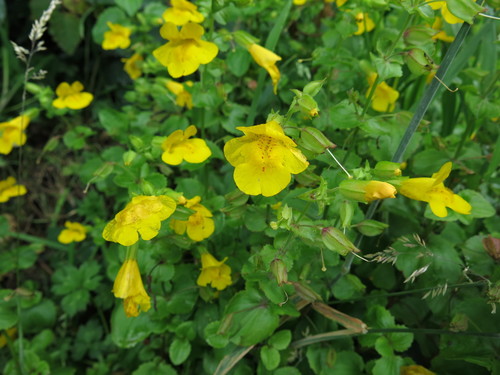
Erythranthe guttata is a highly variable plant that occurs in many forms, and it is considered a species complex because some taxonomic definitions recognize some of its forms as separate species. Plants grow between 10 and 80 centimetres (4 to 31 1/2 inches) tall, and bear disproportionately large tubular flowers 2 to 4 cm long. Perennial forms spread via stolons or rhizomes. Stems may be erect or recumbent; recumbent stems can develop roots at their leaf nodes. Plants are sometimes dwarfed, and may be hairless or lightly covered in hairs. Leaves are arranged oppositely, shaped round to oval, and usually have coarse, irregular teeth or lobes. Bright yellow flowers are borne on a raceme, which most often holds five or more flowers. The five-lobed calyx is much shorter than the full flower. Each flower has bilateral symmetry and is split into two lips: the upper lip usually has two lobes, and the lower lip has three. The lower lip may have anywhere from one large to many small red to reddish brown spots, which gives the species its specific epithet guttata, Latin for 'spotted'. The opening of the flower is covered in hairs. Erythranthe guttata is pollinated by bees, including species in the genus Bombus. Inbreeding in this species reduces both the number and size of flowers, as well as the quality and quantity of pollen. It also displays a high rate of self-pollination. Erythranthe nasuta evolved from Erythranthe guttata in central California between 200,000 and 500,000 years ago, and has since become primarily self-pollinating, with additional differences in genetic code and plant morphology. Erythranthe guttata prefers a wetter habitat than Erythranthe nasuta. This herbaceous wildflower grows along stream banks and seeps across most of western North America, ranging from sea level up to 12,000 feet (3,700 m). Both annual and perennial forms grow throughout the entire range of the species. It blooms in spring at low elevations, and in summer at high elevations. It can be found in a wide variety of habitats, including the Pacific Ocean splash zone, California chaparral, Western United States deserts, Yellowstone National Park geysers, alpine meadows, serpentine barrens, and even on toxic copper mine tailings. It is also very common near water bodies in New Zealand, and is an introduced species in Europe. Erythranthe guttata is cultivated in the specialty horticulture trade, and sold as an ornamental plant for traditional gardens, natural landscapes, native plant gardens, and habitat gardens. Its leaves are edible raw or cooked. Leaves are sometimes added to salads as a substitute for lettuce, and have a mild bitter flavor.