About Erythranthe grandis (Greene) G.L.Nesom
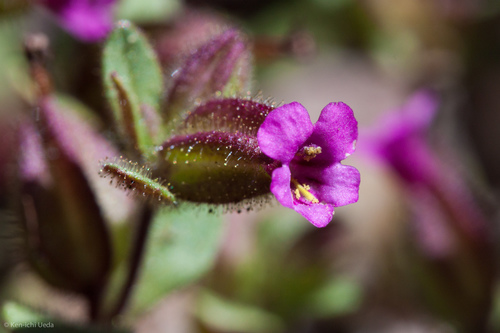
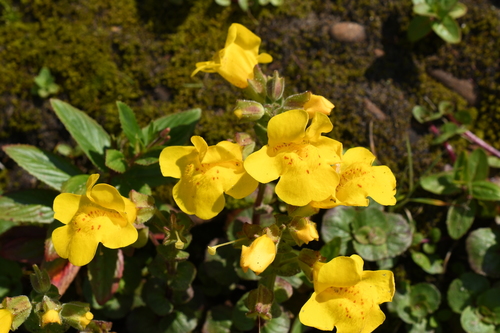
Erythranthe grandis is a coastal perennial plant species closely related to Erythranthe guttata. Before flowering and throughout the winter months, it often grows with a spreading prostrate habit and produces many lateral stolon branches. Peak flowering for this species typically occurs from May through August, which is later than the flowering period of nearby inland populations of E. guttata. In some populations, flowering inflorescences can grow quite elongated. Plant height decreases with increasing latitude, forming very compact plants in northern regions and highly elongated plants in southern regions. Compared to E. guttata, the leaves of E. grandis are typically thicker and often look waxier, especially when the plant grows directly adjacent to the ocean. Leaf margins of E. grandis are generally rounded to dentate. Its stems are typically thicker than those of most E. guttata populations, and they are hollow. The calyxes of E. grandis usually have trichomes, some of which are glandular and some are crinkly. In populations growing from far Northern California into central Oregon, some have red spotting on their calyxes. Many biological researchers still refer to this species as a coastal perennial ecotype of Mimulus guttatus, because it is completely inter-fertile with other inland annual and perennial populations. Molecular genetic analyses have shown that E. grandis populations form a distinct cluster separate from nearby inland E. guttata populations. Although E. grandis has recently been classified as a full species, it can also be considered a coastal perennial ecotype of E. guttata. This species has evolved a higher level of salt tolerance than related inland E. guttata populations. Its range extends along coastal areas from southern California to Cape Disappointment in southern Washington State. It is generally found in coastal seeps, cliffs, dunes, marshes, roadside ditches, or headlands with high soil moisture. Erythranthe grandis has distinctly different morphology from inland annual populations of E. guttata. However, some inland perennial populations of E. guttata do resemble E. grandis. Most trait differences between perennial and annual populations are primarily controlled by a chromosomal inversion that is shared by E. grandis and perennial E. guttata; annual E. guttata generally carries the opposite orientation of this inversion. All E. grandis populations are perennial, and they maintain this life history because lower ocean-side temperatures and coastal summer fog preserve soil moisture and reduce transpiration during the summer dry season. E. grandis has higher levels of herbivore defensive compounds and higher salt tolerance than inland annual populations of E. guttata. These higher levels of herbivore resistance and salt tolerance are likely the result of more herbivores in coastal habitats and the effect of oceanic salt spray on above-ground plant tissues.