About Erythemis mithroides (Brauer, 1900)
This entry covers the dragonfly species Erythemis mithroides (Brauer, 1900), also known as the claret pondhawk. Below is detailed morphological description by life stage and sex, followed by notes on taxonomy, distribution, and ecology.
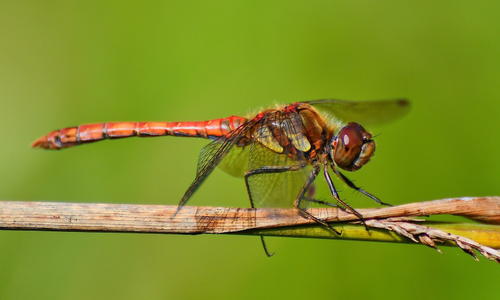
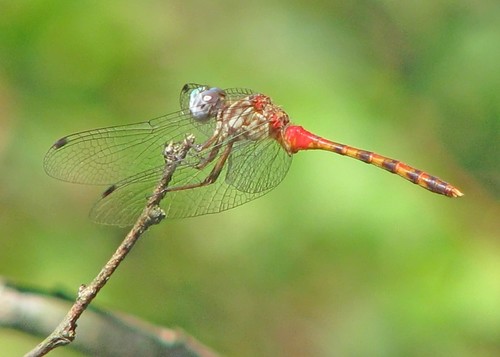
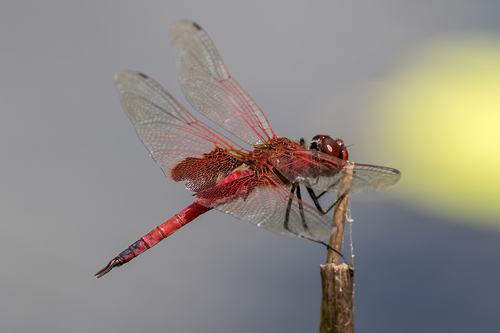
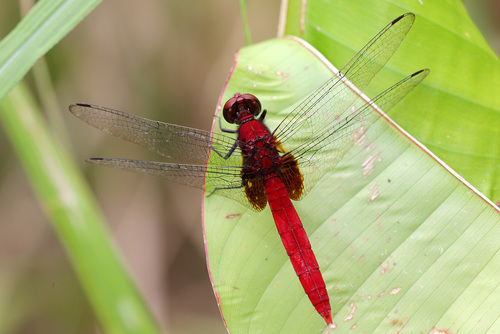
Males have a yellow or brown lip, which may or may not have a dark longitudinal stripe across its middle region. The front and apex are red. The thorax is red or brown with red reflections, and lacks light stripes on its dorsal region. The femur is brown, or brown on the anterior region and black on the posterior region. The tibia may be brown, brown and black, or completely black. The abdomen is entirely red, and the abdominal appendages are also red. The wings have a brown basal spot, with inflamed or hyaline apices.
Females have a yellow lip with green reflections and a longitudinal black stripe across its central region. The front may be black, green, or yellow, and the apex is brown. The thorax is brown with green reflections. Both the tibia and femur are completely black. The abdomen is red with yellow or brown reflections, and the abdominal appendages are red. The wings have a brown basal spot and an inflamed apex. The pterostigma is yellow with a brown costal border.
The larva is small and ochreous in color, with a head that is wider than it is long. The occipital margin is straight and surrounded by setae; the antennae have seven segments; the compound eyes are globular, positioned anterolaterally, and projected forward. The incisors and molars of the jaw are obtuse, and the mandibular formula is L/R 1234/123+4 y/xy abb'/abd. The lip is wide and bears small dark spots. The prementum has 13 setae, and the lateral margin has 11 large, spiniform setae on each side. The labial palp is long, with small dark spots and eight arrows on each side. The movable claw is approximately the same length as the adjacent arrow. The external margin of the palp has 13 small spiniform setae that extend to the fifth bristle of the palp; the internal margin is gently crenulated, with 24 large spiniform setae that alternate with groups of two to nine small setae. The thorax has rounded prothoracic supracoxal processes, surrounded by spines of variable size. The dorsal surface of the prothorax is covered by a row of small setae, and its posterior margin has two rows of short setae on the suture between the prothorax and synthorax. The synthorax has two curved rows of small setae anterior to the spiracle. The wing thecae reach the sixth abdominal segment and have scattered setae on their upper edge. The legs have spiniform setae of variable size; the femur of the second pair of legs has a dark brown circular band at its distal end. The third pair of legs is much larger than the first two pairs. The abdomen is short and cylindrical, with its distal end pointing upwards. The caudal appendages have a large number of setae. The epiproct is triangular, and lanceolate in dorsal view. The cerci are conical and divergent, and exceed half the length of the epiproct. The paraprocts are pyramidal and strongly divergent.
A taxonomic note states that, like other odonate taxa, Erythemis is not a monophyletic group. This is due to extensive homoplasy and structural variability seen in its diagnostic characters. In addition to high intra- and interspecific variation across most characters in the genus, a large number of character states are also shared with other genera.
The claret pondhawk has a wide geographic distribution. It occurs in southeast Texas (USA) and Mexico, across North America, Central America including the Antilles, and South America excluding Chile. In Brazil, the species occurs in all biomes and all river basins.
Erythemis mithroides is an active, brightly colored dragonfly associated with natural and artificial lentic environments, including swamps, marshes, mangroves, river backwaters, lakes, fish ponds, reservoirs, and dams. These environments are typically surrounded by secondary vegetation, degraded riparian forests, agricultural crops, grasses, shrubs, and various anthropogenic areas. Individuals of this species can usually be seen in considerable numbers, perched on grass stems and branches at or near the water's edge, or flying. They generally fly lower than larger related species such as E. haematogastra and E. plebeja. Adult males are territorial, alternating between perching and flying, and continually display heterospecific aggression during mate-finding and food-hunting activities.