About Eryngium maritimum L.
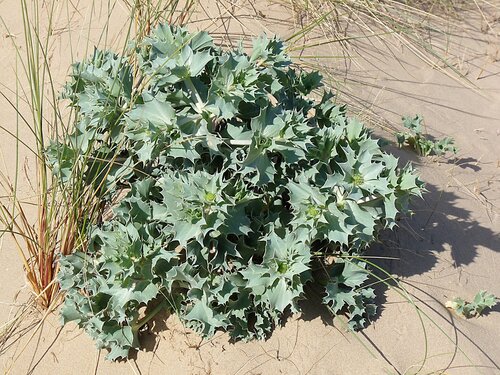
Eryngium maritimum L., commonly known as sea holly, is a bluish-grey, succulent, clump-forming perennial that grows over 50 cm tall. It is entirely hairless, with large, wavy, stiff, spiny leaves. It is adapted to dry conditions as a xerophyte, with a deep, well-developed root system and a waxy leaf cuticle.
The lowest basal leaves measure 5–15 cm, grow on stalks, are rolled when young, and are palmately 3(or 5)-lobed with a roundish outline and a truncate or cordate base. They have thick margins, often have purplish veins, and bear stomata on both sides. Stem leaves are similar in shape but smaller and stalkless. Flower stalks are channelled and dilated at their base. The plant’s cotyledons narrow abruptly into a petiole.
The flowers are bluish white, 8 mm across, and arranged in 1.5–2.5 cm wide heads. A whorl of spiny, leaf-like bracts sits beneath each head, and the small bracteoles among the individual flowers have 3 spines each. Sepals measure 4–5 mm, longer than the petals. Flowering occurs from June to September, and the flowers attract butterflies. The fruit is 13–15 mm, more or less uncompressed, and covered in stigmatic papillae that grow longer toward the apex. Styles are around 6 mm long, divergent to somewhat recurved. The chromosome number of this species is 2n = 16. Sea holly can be easily identified by its bluish-grey holly-like spiny leaves, along with its specific coastal habitat of sand or sometimes shingle.
This species is native to coasts across most of Europe and the Mediterranean, with a wide native range extending to adjacent parts of northern Africa and the Middle East, where it grows on the shores of the Atlantic Ocean, the Baltic Sea, the Mediterranean Sea, the Black Sea, and the Sea of Azov. Its distribution extends north into Denmark, Germany, Poland, Lithuania, Latvia, Estonia, the Skagerrak strait, and the Swedish islands of Gotland and Öland. In Scandinavia, its range is relatively southerly, only reaching as far north as southern Norway and Sweden. In Great Britain, it grows along the coasts of England, Wales, and Ireland, but it has become largely rare or extinct along the coasts of northeast England and much of Scotland, where it was once more common and widespread. It was formerly recorded in Shetland, but never properly established at this northernmost edge of its native range; the last documented occurrence in Shetland was at Fitful Head in 1884, where it is thought to have been widespread on the sands of the Bay of Quendale. Sea holly has been introduced to parts of eastern North America, where it was once valued as an ornamental for coastal restoration. It has also been introduced to Australia alongside planted marram grass.
Sea holly characteristically grows on well-drained substrates in sand dunes and shingles, and is restricted to regions with mild winters. More rarely, it can be found on rocky coasts where patches of sand sit between artificial hard coastal protection features with a structure similar to shingle. In northern Britain, its distribution is limited by a lack of suitable dune systems. It tolerates the harsh conditions typical of beach and coastal dune habitats: low soil nutrient levels, frost, strong salty winds, high temperatures and insolation, and periodic sand burial. It associates with various shingle and strandline plant communities, growing scattered within the vegetation. On shingles, it occurs in the Honckenya peploides-Cakile maritima strandline community above the tidal limit. On dunes, it can be found growing in the Elymus farctus ssp. boreali-atlanticus foredune community, the pioneer vegetation on foredunes dominated by Elytrigia juncea (also called E. farctus).
Sea holly is a poor ecological competitor that generally thrives in open areas. It declines when habitats are invaded by shrubby species such as Rosa rugosa, Hippophae rhamnoides, Elaeagnus commutata, and Salix repens, due to heavy shading. It is a light-demanding plant, but its succulent equifacial leaves protect it from water stress caused by excessive sun exposure. It has deep, well-developed taproots for water storage, which allow it to survive long dry periods in its coastal habitat. Its root system also has high plasticity in response to the shifting dynamics of coastal ecosystems, and can develop a rhizome-like structure. When subject to permanent sand burial, for example, root internodes gradually lengthen to bring perennating buds closer to the ground surface, ensuring the plant survives through subsequent growing seasons.
Like other species in its genus, E. maritimum has been traditionally used to treat a range of ailments, largely due to its high antioxidant activity and content of phenolic and flavonoid compounds. It has been used for its diuretic, stimulant, cytotonic, stone-inhibiting, aphrodisiac, expectorant, and anthelmintic properties. Essential oils extracted via hydro-distillation from the plant’s aerial parts contain oxygenated sesquiterpenes with antimicrobial activity against E. coli and L. monocytogenes. The roots of E. maritimum were formerly candied as a sweetmeat, and Dioscorides recommended them as a remedy for flatulence. Young shoots of the plant can also be eaten like asparagus.
Sea holly has often been featured in paintings and other artwork, including works by Irish artist Patrick O’Hara, and on postage stamps: the 1967 one-franc stamp in Belgium, and the 25-pfennig stamp in Germany. It is also mentioned in various plays and poems, most notably in William Shakespeare’s The Merry Wives of Windsor and in Johann Wolfgang von Goethe’s Italian Journey. In The Merry Wives of Windsor, it is referenced in a speech by Falstaff: "Let the sky rain potatoes; let it thunder to the tune of Green-sleeves, hail kissing-comfits and snow eringoes [sea-holly], let there come a tempest of provocation..." It was nominated as the 2002 County flower for the city of Liverpool, and asteroid 199194 Calcatreppola was named after this plant; the official naming citation was published by the Minor Planet Center on 25 September 2018 (M.P.C. 111803).