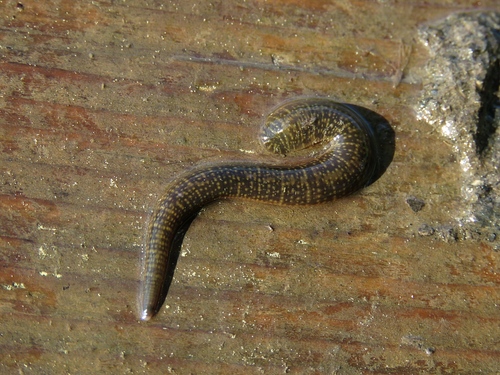
About Erpobdella octoculata (Linnaeus, 1758)
Erpobdella octoculata (Linnaeus, 1758) is a tube-shaped leech species that grows between 3 and 7 centimeters long. Like all leeches, it has exactly 32 fixed body segments. Segments 1 through 4 make up the head region, which holds the brain and the oral sucker. Segments 5 through 25 form the mid-body, where all internal bodily organs are located. The tail sucker is contained within segments 26 through 32. Body color ranges from yellow-green to reddish-brown, and this variation is determined by the number of non-pigmented spots surrounding the sensory buds. Individuals with a higher proportion of non-pigmented spots on their back are yellow-green, while those with more pigment are reddish-brown. Body color also matches the substrate at the bottom of the species' aquatic habitats; leeches found on stony substrates tend to be lighter, while those on aquatic plant substrates tend to be darker. E. octoculata has four pairs of black eyes. Two pairs of labial eyes are located on either segment 2 or segment 3, and two pairs of smaller buccal eyes sit on segment 4. Labial eyes have six layers of photoreceptor cells, while buccal eyes only have three layers. This is one of the most common freshwater leech species in Europe, with records from more than 20 countries across the continent. It is more abundant in fast-flowing rocky-bottomed streams and rivers than other leech species, and it prefers acidic, low-nutrient bodies of water. It has also been found to be abundant in polluted streams in Poland. The full life cycle of E. octoculata lasts between 1 and 3 years. Adult leeches are identified by the presence of a clitellum, which secretes the species' oval-shaped cocoons. Each cocoon holds approximately 5 to 10 eggs. Most individuals produce cocoons within one year of hatching and die shortly after. If an individual does not breed in its first year, it will breed at two years of age and produce a second set of cocoons at three years of age before dying. Variation in life cycle length may be explained by environmental conditions including water temperature, food availability, and dissolved oxygen levels. E. octoculata is a hermaphrodite, so it has both male and female gonopores, which open on the dorsal surface of the body. Due to its ability to survive in polluted water, this leech species is used as a bioindicator. A study by Macova et al. demonstrated that contamination levels can be measured based on the amount of pollutants stored in the tissues of E. octoculata.

