About Erodium moschatum (L.) L'Hér.
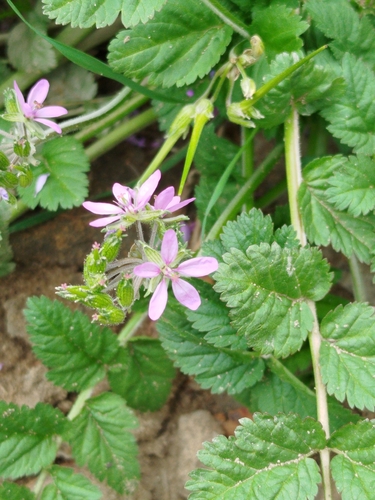
Musk stork's-bill, scientifically named Erodium moschatum (L.) L'Hér., is an annual monoecious herb that grows in a sprawling habit, ranging from procumbent to erect, and reaches up to roughly 60 cm long or tall. When bruised, it gives off a musky scent. Almost all parts of the plant are covered in either simple or sticky glandular hairs, with the exception of its fruits and petals. Its stems range in colour from green to purple, and bear alternate or opposite pinnate leaves that grow up to about 10 cm long, though very large plants may have leaves up to 30 cm long. The leaf segments are serrated and lobed, but never deeply lobed—lobing extends no more than a quarter of the way toward the midrib. Leaf petioles are somewhat shorter than the leaf blade, and have papery stipules up to 10 mm long at their base. Its inflorescences are umbels holding 6 to 12 flowers, borne on peduncles up to 10 cm long. Small papery bracts around 3 mm long grow at the top of each peduncle. Individual flowers are actinomorphic and hermaphroditic, borne on short pedicels that elongate as the fruit develops. Each flower has 5 glandular-hairy sepals a few millimetres long, 5 pale purple petals around 7 mm long, five fertile stamens, five sterile staminodes, a single style, and five stigma arms. The fruit is a schizocarp that splits into 5 mericarps. Each mericarp has a short 5 mm basal segment that holds one black seed, and a long 40 mm beak that splits open at maturity to expose a feathery appendage that allows wind dispersal of the seed. At the top of the basal segment, there are two noticeable pits, which contain papillose glands—this is a feature that sets it apart from other stork's-bills. For identification, musk stork's-bill can be distinguished from other British stork's-bills by its musky scent, its once-pinnate leaves, and the glands inside the apical pits on its fruit. Seeds are ejected from the beak-like fruit structures and commonly attach to animal fur, a process aided by the coiled needle-like shape of the seed structure. Several insect species have been recorded on musk stork's-bill. These include the midge Dasineura erodiicola, which forms galls on the plant's flowers. Two moth species, the Setaceous Hebrew character and Thaumetopoea herculeana, feed on the plant's leaves, alongside the weevil Donus dauci and the green peach aphid. Two types of mildew, Podosphaera erodii and Peronospora erodii, infest the leaves, and rust caused by Synchytrium papillatum can form pustules on the leaves. Additional recorded pests are the leaf miner Agromyza nigrescens, the aphid Acyrthosiphon malvae, the leaf beetle Aphthona pallida which feeds on the plant's roots, and the weevil Zacladus exiguus which bores into the root collar. Like Erodium cicutarium, Erodium moschatum is edible.