About Erodium maritimum (L.) L'Hér.
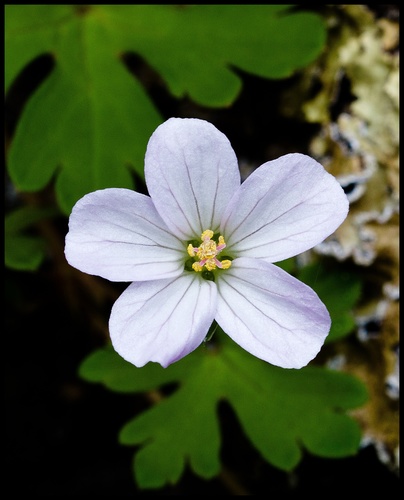
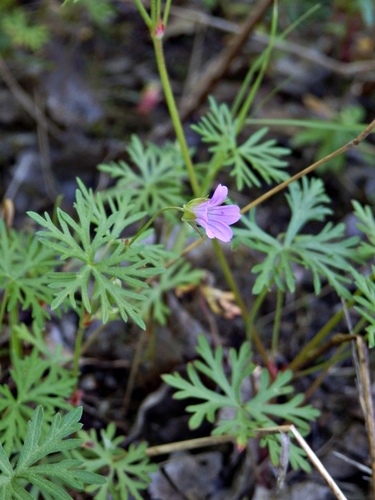
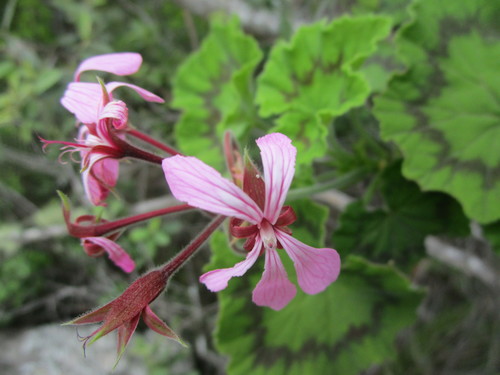
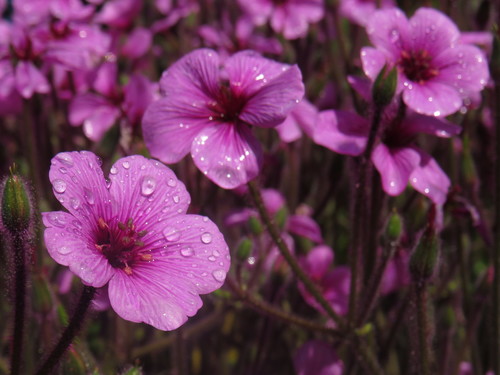
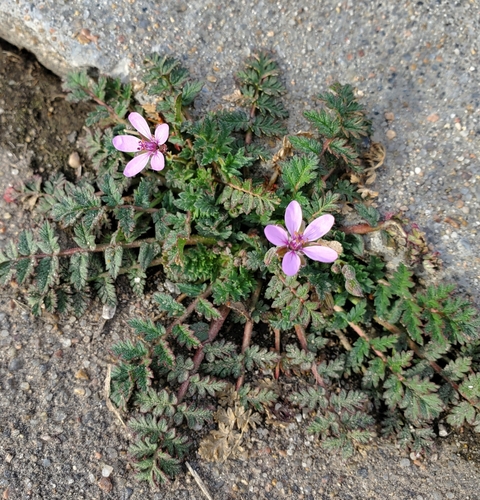
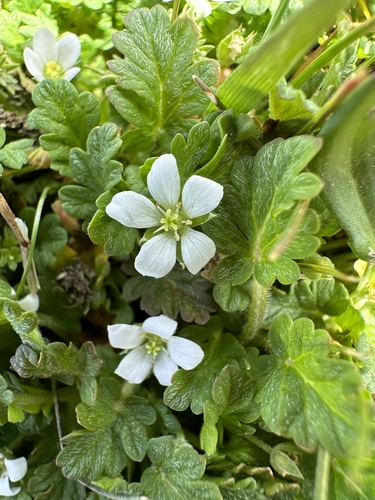
Sea stork's-bill, scientifically Erodium maritimum (L.) L'Hér., is a perennial monoecious herb that typically forms flat-pressed rosettes growing along the ground, with a deep taproot that lets it survive summer on dry soils. Its leaves are all or mostly basal; if the stem elongates, leaves are arranged in opposite pairs. Leaves are simple, oval-shaped, up to 2 cm long, shallowly lobed and distinctly toothed, with petioles that can be as long as or longer than the leaf blade. The leaf surface is marked with long, white, appressed hairs. The actinomorphic flowers grow singly, and occasionally in pairs, emerging from the center of the rosette on short pedicels covered in spreading hairs. These hermaphroditic flowers have five green, pointed, hairy sepals a few millimeters long. Most often, they have no petals at all, but may sometimes produce small white petals around the same size as the sepals; any petals that form fall off soon after flowering. There are five stamens and five carpels, which develop into beaked mericarps shaped like miniature storks' bills, less than 1 cm long. Flowers are usually self-pollinating. Sea stork's-bill can be distinguished from other stork's-bill species in its growing regions by its leaf structure: common stork's-bill and sticky stork's-bill have twice-pinnate leaves, musk stork's-bill has 1-pinnate leaves, while sea stork's-bill has simple leaves. Soft stork's-bill and Mediterranean stork's-bill also have simple leaves, but like the other three species, both have large, persistent petals, while sea stork's-bill usually lacks petals entirely. For formal technical confirmation, the pit at the apex of the mericarp is hidden by long hairs in sea stork's-bill, while it is typically visible in all other stork's-bill species. Sea stork's-bill is almost entirely restricted to western Europe, with a strongly Atlantic distribution centered mainly on south-western Britain, southern Ireland, and Brittany. Its range extends to north-western Spain and the western Mediterranean as far as Italy. In North Africa, it has only been recorded in the Canary Islands (specifically La Palma, Gran Canaria, and Tenerife), Tunisia (where a 1884 specimen collected at Nabeul is held by the Paris Museum of Natural History) and the island of Zembra. Some sources list it as introduced to Tasmania, but a 2021 plant census did not record the species there. Its global conservation status has not been assessed, but in Britain, where it is most common, it is classified as LC (Least Concern) and is clearly increasing in south-east England and East Anglia. It is also generally classified as LC in mainland France. In France, it is restricted to a short stretch of coastline from the Cotentin Peninsula through Brittany to the Pays de la Loire, and is considered VU (Vulnerable) in Normandy and the Loire region. The isolated Corsican population is also classified as LC. By contrast, it is categorized as Critically Endangered in Spain. In some British counties, mostly in the west, sea stork's-bill is considered an axiophyte, a species characteristic of high-value habitats. For example, in Cardiganshire it grows on stony slopes and screes on south-facing hillsides such as Foel y Mwnt, though it is sometimes also found in less natural sites including the station platform at Borth. Eastern British counties such as Kent do not typically classify it as an axiophyte. The native habitat of sea stork's-bill is generally rocky, stony ground near the coast, with free-draining soil. It is mesotrophic, calcifugous, and xerophilic. In Britain, it was historically also found in an alternative habitat of short, acid grassland in inland areas, but it has disappeared from most of these inland sites. One exception is the Long Mynd in Shropshire, where it was first recorded over 200 years ago by Jamaican-English botanist Mary McGhie and still persists today, growing in U1 sheep's sorrel grassland on a south-facing shale hillside at 220 m above sea level. Secondary populations occasionally appear on roadsides, railway lines, walls, quarries, and car parks, but these populations do not tend to persist long-term. In Corsica, it occurs at all altitudes, ranging from coastal dunes to over 1,500 m inland. While it normally avoids alkaline soils, it has been recorded growing on limestone hills near Bristol. At these sites, it grows either "overlooking salt water... or in valleys that were once arms of the sea; never inland", which suggests saline influence is a more important factor for its growth than soil type. Its Ellenberg values in Britain are L = 9, F = 4, R = 6, N = 6, and S = 3, which confirms that it favours brightly lit locations with low moisture, circumneutral acidity, moderate fertility, and high salinity. Although classified as a perennial, sea stork's-bill often behaves like a spring annual: it grows abundantly in wet years and sometimes disappears entirely above ground during dry summers. In the European Habitats System, the only vegetation community that includes sea stork's-bill is N34 "Atlantic and Baltic soft sea cliffs", where it is a diagnostic species. This habitat is protected under the Bern Convention. It is not mentioned in the British National Vegetation Classification. No known insect associations have been recorded for sea stork's-bill. While it is commonly self-pollinating, ants and flies are known to visit its flowers, though this visitation does not appear to increase seed production. Seed dispersal is thought to happen through endozoochory (specifically, being eaten but not digested by rabbits) and epizoochory (carried on animal fur). Though it is sometimes reported growing in gull colonies, studies have found no evidence that seeds are carried by seabirds.