About Erodium lebelii Jord.
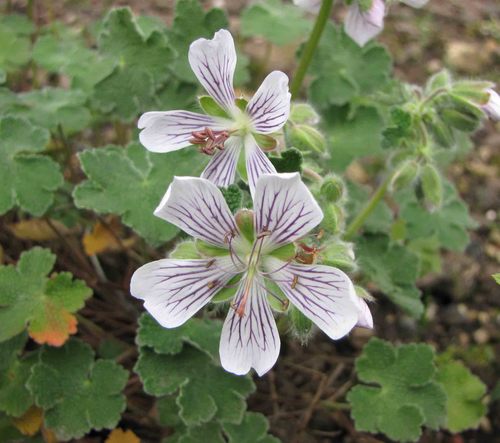
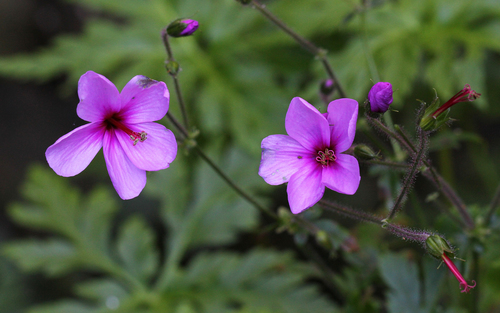
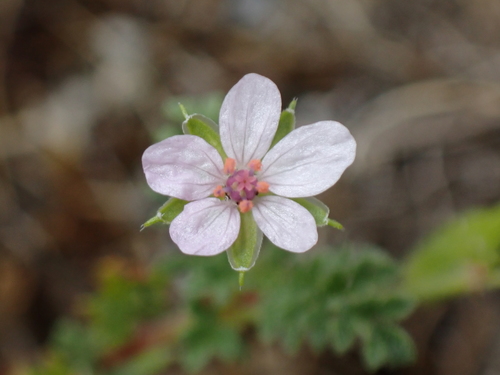
Erodium lebelii Jord., commonly called sticky stork's-bill, is an annual, monoecious herb that typically forms rosettes pressed flat to the ground. It has a deep taproot that allows it to survive summer on dry soils. Its stem is often very short, but can reach up to 15 or even 25 cm in length; stems are green or reddish, covered in dense glandular hairs, particularly near the top. Leaves are all or mostly basal, but arranged in opposite pairs if the stem elongates. Each leaf is deeply divided or pinnate, with deeply incised segments cut more than halfway to the base, growing up to 3 cm long, and covered in white hairs. Leaf petioles are also hairy, and somewhat shorter than the leaf blade. Several inflorescences can develop; these are umbels holding 2–4, sometimes 5, actinomorphic flowers that arise from the tops of branched stems. Flowers are held on densely glandular-hairy pedicels around 1 cm long. Flowers are hermaphroditic, with 5 glandular-hairy sepals a few millimetres long, and 5 white to pinkish petals 5 mm long. There are also five stamens and five carpels, which develop into fruits shaped like a miniature stork's bill. Each fruit is a schizocarp that splits into 5 mericarps. Each mericarp has a short 5 mm basal segment containing one black seed, and a long 20 mm beak that splits open at maturity to reveal a feathery appendage that enables wind dispersal of seeds. At the top of the basal segment there is a large, shallow pit that, unlike the pit in common stork's-bill, is not surrounded by a ridge and groove, but is partially covered by long white hairs on the body of the mericarp. Sticky stork's-bill is very similar in appearance to common stork's-bill, especially the coastal variety E. cicutarium ssp. dunense. Key identifying features of E. lebelii are the dense glandular hairs on its pedicels and sepals, the greyish appearance of its leaves, its pale flowers which usually grow in pairs rather than larger groups, the apical pit of the mericarp that is not surrounded by a ridge and groove, and unspotted petals. Confirmation of identification can be done via a chromosome count. Musk stork's-bill is sometimes very glandular and sticky, but its pinnate leaves have leaflets that are almost entire, and it bears large pink flowers. Sticky stork's-bill is almost entirely restricted to western Europe, where it grows mainly along the Atlantic coast from Germany to Spain, and along the Mediterranean coast of Italy, Corsica, mainland France and Spain. It probably extends to Morocco in North Africa, but there are taxonomic uncertainties about more southerly populations. If Erodium lebelii is truly conspecific with E. aethiopicum, it also occurs along the entire Mediterranean coast of Africa. Its global conservation status has not been assessed, but in Britain and France it is listed as Least Concern (LC), though in Picardy, near the northern edge of its range, it is classed as Vulnerable (VU). In Germany it is classed as not threatened. In some British counties, sticky stork's-bill is considered an axiophyte, meaning a species typical of valuable habitats, but in others, such as Cardiganshire, it is considered a non-persistent casual. The native habitat of sticky stork's-bill is loose coastal sand dunes. It is mesotrophic, calcifugous and xerophilic. Its Ellenberg values are L = 8, F = 4, R = 7, N = 2, and S = 0, which indicate it favours brightly lit sites with low moisture, circumneutral acidity, low fertility, and low salinity. No known associations between insects and sticky stork's-bill have been recorded to date.