About Erodium cicutarium (L.) L'Hér.
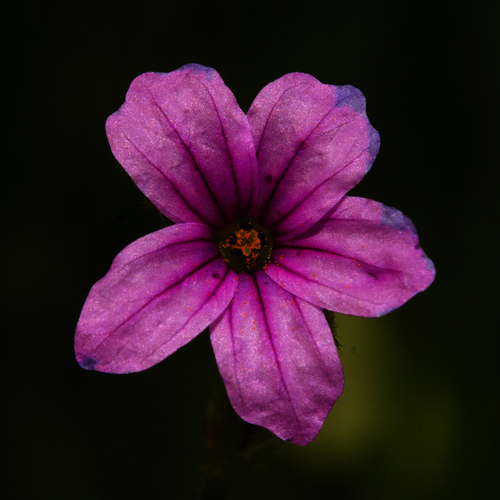
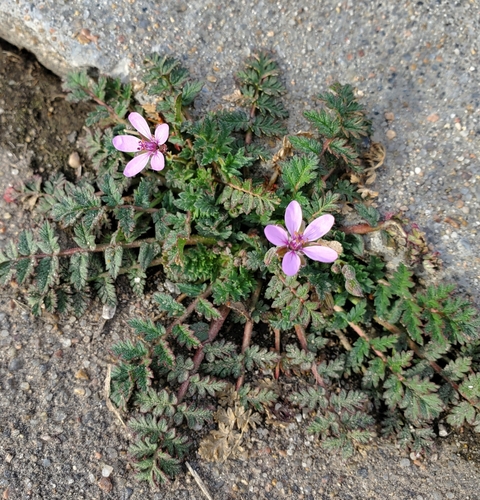
Common stork's-bill, scientifically known as Erodium cicutarium (L.) L'Hér., is a perennial monoecious herb. It typically forms rosettes that lie flat against the ground, and has a deep taproot that lets it survive summer on dry soils. It can produce stems up to 60 cm long; stems may be red or green, erect or prostrate, and covered in either simple or glandular hairs, which become more dense toward the top of the stem. Plants with glandular hairs are sticky, while those with only simple hairs are far less sticky. The plant has no scent. Early in the growing season, leaves grow in a basal rosette; later, leaves grow in opposite pairs along the stems. Leaves are pinnate, and nearly twice-pinnate because each leaflet is deeply toothed or divided more than halfway to the midrib. The full leaf ranges from 2 to 20 cm long, and may or may not have a petiole. Like stems, leaves can be covered in glandular or simple hairs. Stems carry bright pink flowers, which often have dark spots at their bases. Flowers grow in loose clusters, and have ten filaments (five of which are fertile) plus five styles. The plant produces a long seed pod shaped like a stork's bill; when ripe, this pod bursts open in a spiral, launching seeds that have long tails called awns into the air. Erodium cicutarium has a very large native range. It is native to all of Europe except Iceland. In Africa, its native range extends across the north from Morocco to Egypt, and also includes Chad and Eritrea, but not Sudan. According to Plants of the World Online, it is native to most of Asia, excluding Southeast Asia, central China, and Mongolia. It has been introduced and now grows in Taiwan, Korea, Japan, and the eastern half of the Russian Far East. It is widespread across North America. In the northern half of North America, it grows as an annual. In southern parts of North America, it usually grows as a biennial, with a more erect growth habit and much larger leaves, flowers, and fruits. It flowers from May to August. Common stork's-bill grows in bare, sandy, grassy areas both inland and along coasts. It is a food plant for the larvae of the brown argus butterfly, and its seeds are collected by multiple species of harvester ants. The young leaves of Erodium cicutarium are edible raw or cooked. The whole plant is reportedly edible when picked young, with a flavor similar to sharp parsley. John Lovell's 1926 work Honey Plants of North America notes that the pink flowers are a valuable source of nectar for honey, and also produce large amounts of pollen. Among the Zuni people, a poultice made from chewed root is applied to sores and rashes, and an infusion of the root is taken to treat stomachache.