About Eristalis transversa (Wiedemann, 1830)
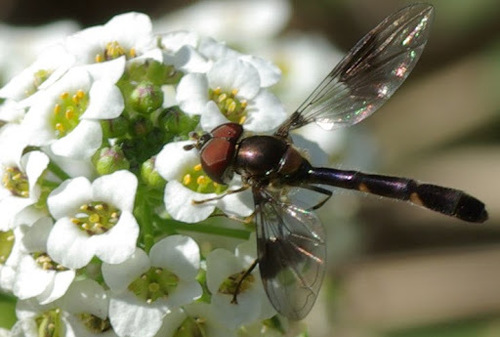
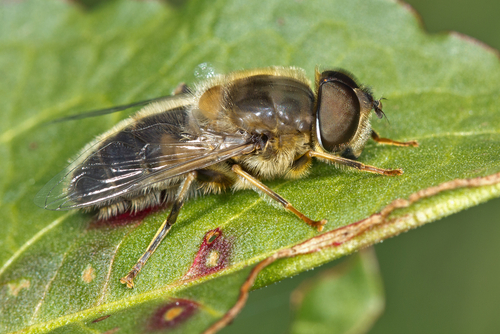
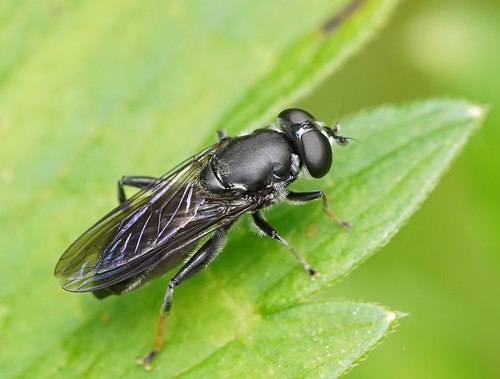
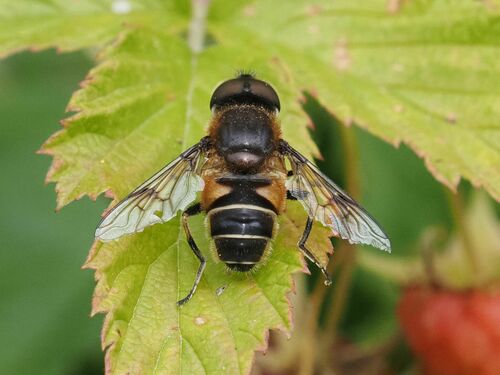
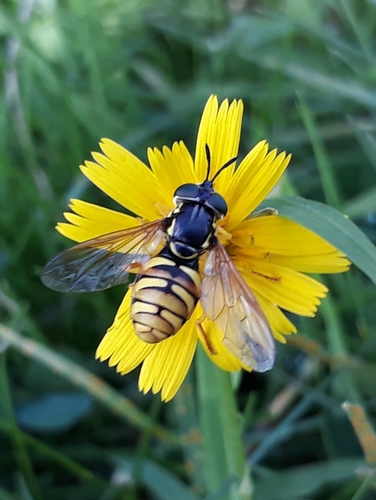
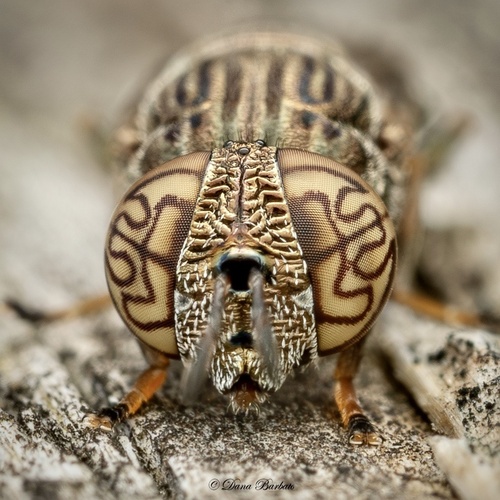
Description terminology follows that used in Morphology of Diptera. This species ranges in size from 7–12 mm (0.28–0.47 in). For the head: male eyes are pilose on the upper half and broadly contiguous. The front is black, shining in the middle, with black pile on the sides. Females also have black pile on the front, which is narrowed above, and the lower two-thirds of the front is reddish pollinose. Antennae are reddish yellow, and the basal portion of the arista is sparsely plumose. The sides of the face are covered with dense whitish pollen and whitish pile, while the median stripe (tubercle) and cheeks are shining black. For the thorax: the notum is opaque black with three grayish olive transverse bands. The pleurae are covered with thick yellow pile. The scutellum is bright yellow, with a narrow black strip along its base. For the abdomen: the first segment is black. The second segment has large yellow lateral triangles (smaller in females) and a narrow posterior yellow ring, on a black background that extends narrowly to the lateral margins. The third segment has large spots on the front sides connected by a yellow ring against a black background, and a yellow ring borders the rear of the segment; females only have a posterior yellow ring on a black background here. The fourth segment has a small yellow spot on the front quarters and a posterior yellow ring, with the rest of the segment opaque black with a complete shining cross-band before the segment's middle; females only have a posterior yellow ring on a black background here. The hypopygium is shining black. The wings are hyaline, with the basal portion slightly yellowish. Notable wing venation includes a spurious vein (sv), looping of R4+5 into r4+5, a closed cell r2+3, and an anterior cross-vein (r-m) that is oblique and located near the middle of the discal cell (dm). Leg color is variable. They are usually black with yellow at the tip of the femora and the base of the tibiae. Sometimes the distal half of all femora, the base of the hind tibiae, all femora, and the larger portion of the tarsi are yellow. More rarely, the front and middle legs may be almost entirely yellow, with black confined to the outer part of the hind femora. Black is also present at the tip of the hind tibiae and the tip of all tarsi. This species has been reported from North America east of the Mississippi River, and ranges into Southeastern Canada.