About Eristalis tenax (Linnaeus, 1758)
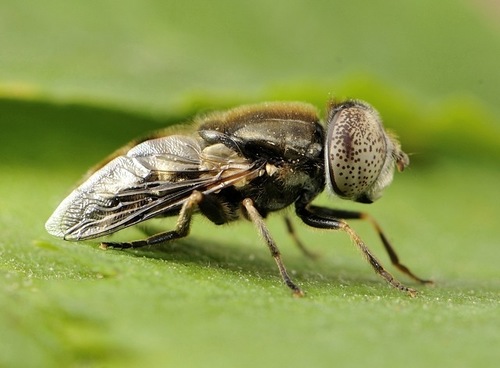
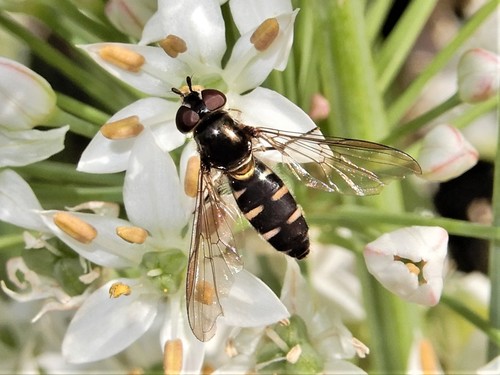
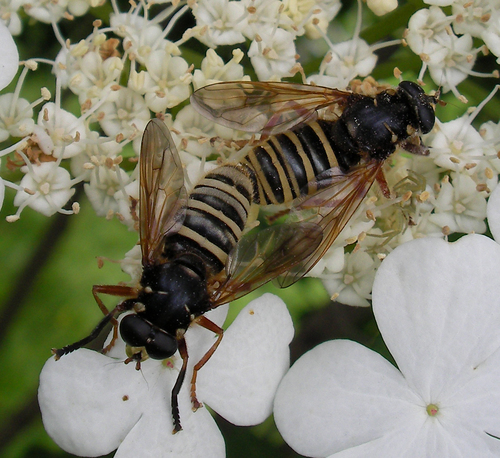
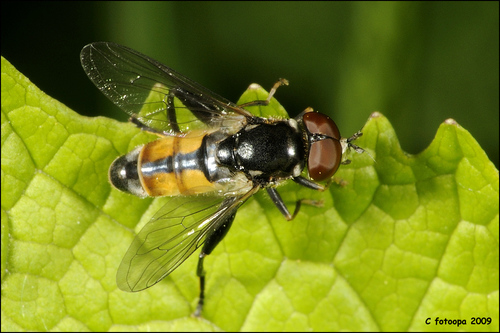
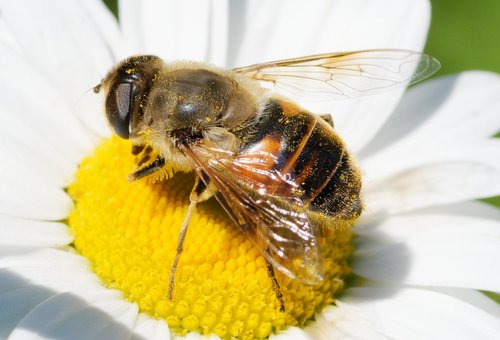
Eristalis tenax, commonly called the drone fly, is a large, stocky bee mimic. Its eyes are marbled in black, and males perform hovering mating displays. This species has an average wing length of 9.75–13 mm and an average wingspan of 15 mm. Its exact appearance varies considerably. Abdominal color ranges from dark brown to orange, and abdominal pigmentation plays an important role in regulating body temperature: black areas along the center of the abdomen may absorb solar radiation to warm the dorsal blood vessel that lies directly underneath. Despite this individual variation, the orange-to-brown spots on its second abdominal segment are typically more rounded than those of other drone fly species. Its hind tibiae are entirely black or brown, and thickened at the midpoint. The setae directly above the base of its antennae are dark. The larval stage of Eristalis tenax, known as the rat-tailed maggot, occurs on every continent except Antarctica, and ranges into the highest northern latitudes. The species is not prevalent in extremely southern latitudes, and is also not common in arid regions of Europe, Asia, and Africa. In the United States, it is found as far north as Alaska, and as far south as California and Florida. Eristalis tenax eggs are usually laid on the surface of water, and develop through three distinct larval stages. Larvae typically live in still or stagnant water, such as water reservoirs or liquid dung. Larvae leave their aquatic environment just before entering the pupation stage. Many details of the drone fly’s full life cycle remain poorly understood, and more detailed research is needed. Mating can occur while a pair of E. tenax is flying, with the male positioned above the female, or on the ground when the female is resting on foliage. After mating, adult females lay clusters of around 10 eggs near dirty, contaminated water, sewage, or decomposing organic material. Diptera (true flies) are an important, often overlooked group of pollinators that play a significant role in pollinating both agricultural plant diversity and wild plant biodiversity globally. Hoverflies are less specialized pollinators than bees, and are more effective pollinators of open flowers than tubular flowers. Pollination efficiency differs significantly between bees and flies.